POS Demos in Merchant Services: How to Win More Deals
POS Demos in Merchant Services: Why Showing Business Owners the Technology Creates Opportunities
Want to create more opportunities in merchant services? Stop talking only about processing rates and start showing business owners what better technology can do for their business.
I've been in the merchant-services industry since 2009, and I've watched this business evolve tremendously.
When I first started, many sales conversations centered around credit card terminals, processing statements, and whether you could save a merchant money.
Those conversations still matter.
But the industry has changed.
Today, many business owners are evaluating much more than the cost of accepting a credit card.
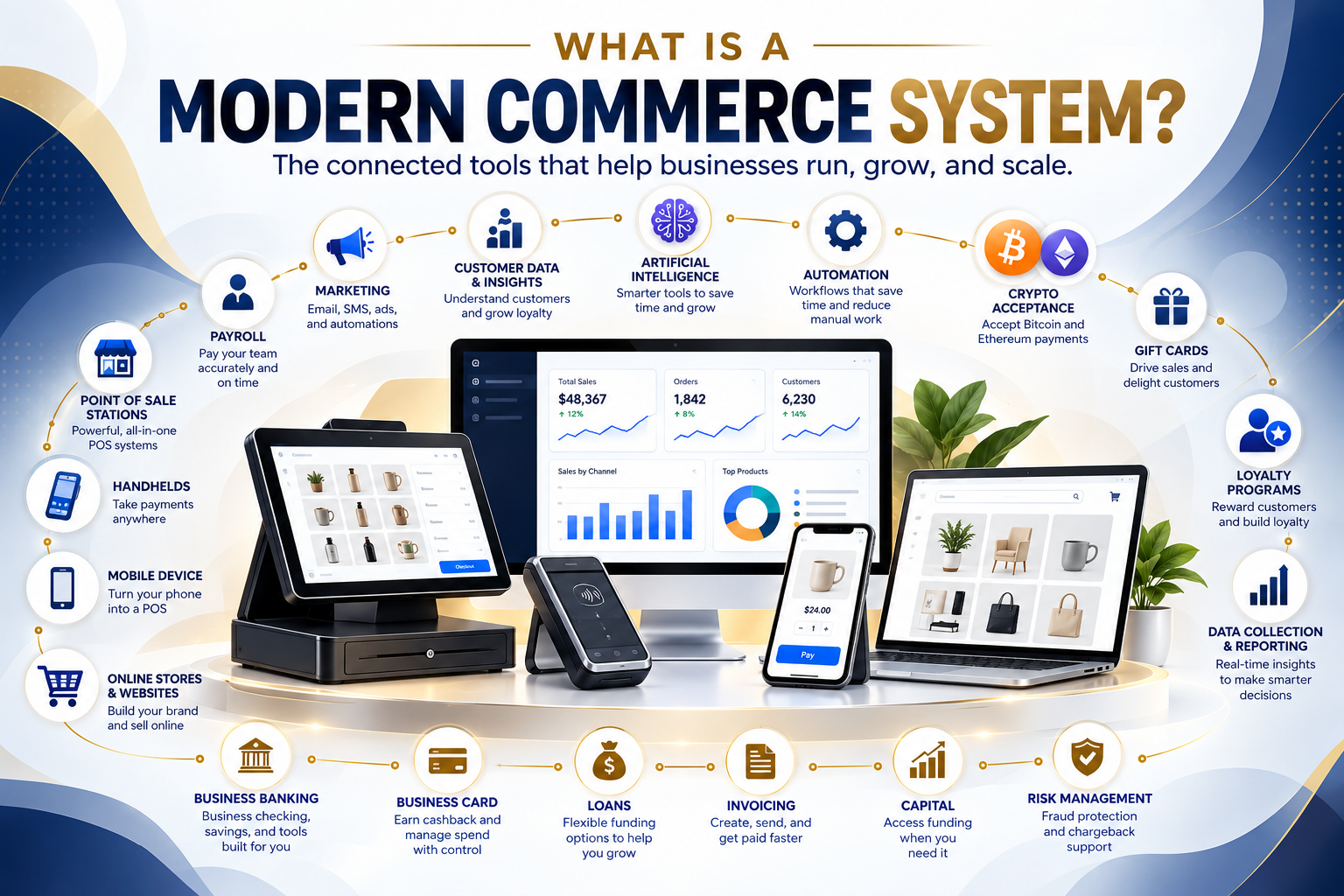
They're looking at point-of-sale systems, online ordering, inventory management, employee management, reporting, customer experiences, and the technology they rely on to operate their businesses.
And that creates an opportunity for merchant-services agents who are willing to learn how to sell more than a processing rate.
One of the most important activities I teach agents to focus on is conducting qualified POS demonstrations.
In fact, two qualified POS demonstrations per week is one of the three core weekly production benchmarks I've established for merchant-services agents.
Why?
Because a good demonstration can turn a conversation about payment processing into a much more meaningful discussion about improving the merchant's business.
And when you help a business owner solve a real problem, you give yourself another opportunity to earn their business.
This is the third activity in my Merchant Sales Production Formula, alongside prospecting and proposals.
Let's talk about why it matters and how to do it effectively.
Merchant Services Is About More Than Processing Rates
For years, one of the most common sales approaches in merchant services has been simple:
Walk into a business.
Ask for the processing statement.
See whether you can save them money.
Present a quote.
Try to close the deal.
And there's nothing inherently wrong with reviewing a merchant's processing costs.
Saving a business money can provide real value.
But here's the problem.
If the only value you offer is a lower processing rate, you're competing in one of the most crowded parts of the industry.
There will almost always be another salesperson willing to promise a cheaper rate.
And if the merchant believes every processor offers essentially the same thing, the entire conversation can become a race to the bottom.
Modern commerce technology gives you another way to approach the business.
Instead of asking only, "What are you paying for processing?" you can also ask:
Is your current POS system doing everything you need?
Are there problems with your ordering or checkout process?
Can you access the reporting you need?
Is your inventory system easy to manage?
Are you happy with your current support?
Are you paying for software features you don't use?
Is your current system creating unnecessary work for employees?
Those questions open a different kind of conversation.
You're no longer talking exclusively about price.
You're talking about how the merchant operates their business.
And that's where a qualified POS demonstration can become extremely valuable.
My Recommended Benchmark: Two Qualified POS Demos Per Week
In my Merchant Sales Production Formula, I recommend three weekly activity benchmarks for agents using an in-person prospecting model:
Production Activity | Weekly Benchmark |
|---|---|
Business doors | 100 |
Qualified proposals | 6 |
Qualified POS demonstrations | 2 |
These are the activity targets I developed to help agents focus on measurable actions that create and advance sales opportunities.
They're not guaranteed closing formulas.
And they're not universal requirements for every merchant-services agent.
But I believe they provide a useful standard for consistent production.
Why Two POS Demonstrations?
A POS demonstration typically requires more preparation than a basic prospecting conversation.
You need to understand the merchant's business.
You need to identify an actual need.
You need to coordinate the demonstration.
And you need to show the merchant how the proposed technology addresses their situation.
In some cases, you'll also need to involve a product specialist or implementation representative.
That's why I recommend two qualified demonstrations per week rather than simply telling agents to schedule as many as possible.
The objective is to create a consistent flow of legitimate technology opportunities.
What Counts as a Qualified POS Demo?
I don't want agents counting every casual product conversation as a POS demonstration.
A qualified demo should involve a business with a potential need for the solution being presented.
Ideally, you should have:
Identified a specific operational or technology need
Confirmed that the system could be a reasonable fit
Established interest in evaluating the solution
Included an appropriate decision-maker
Scheduled a meaningful demonstration
Created an opportunity for questions and discussion
The merchant doesn't have to be ready to sign that day.
But there should be a legitimate reason for the demonstration.
Two qualified demos with interested business owners are more valuable than ten generic product walkthroughs with people who have no reason to change.
Why POS Demonstrations Create Different Sales Opportunities
Let's imagine you're prospecting a restaurant.
You introduce yourself and ask whether the owner would be interested in reviewing their payment-processing costs.
They tell you they're happy with their current rates.
If processing price is the only thing you sell, that conversation might end right there.
But suppose you notice they're using an older POS system.
You ask whether they're happy with how it handles orders, reporting, and daily operations.
The owner tells you they've been frustrated with the system for months.
Now you have a different conversation.
Instead of trying to convince them to change processors for a small pricing difference, you're discussing a problem they already want to solve.
Maybe they need better reporting.
Maybe their current system is difficult for employees to use.
Maybe they want to improve online ordering.
Maybe they're unhappy with support.
A qualified POS demonstration gives you an opportunity to show them what an alternative system might offer.
That doesn't mean every demonstration will become a sale.
But it creates a more relevant reason for the business owner to consider a change.
The best sales opportunities often begin when you identify a problem the merchant already cares about.
Stop Selling Features. Start Solving Business Problems.
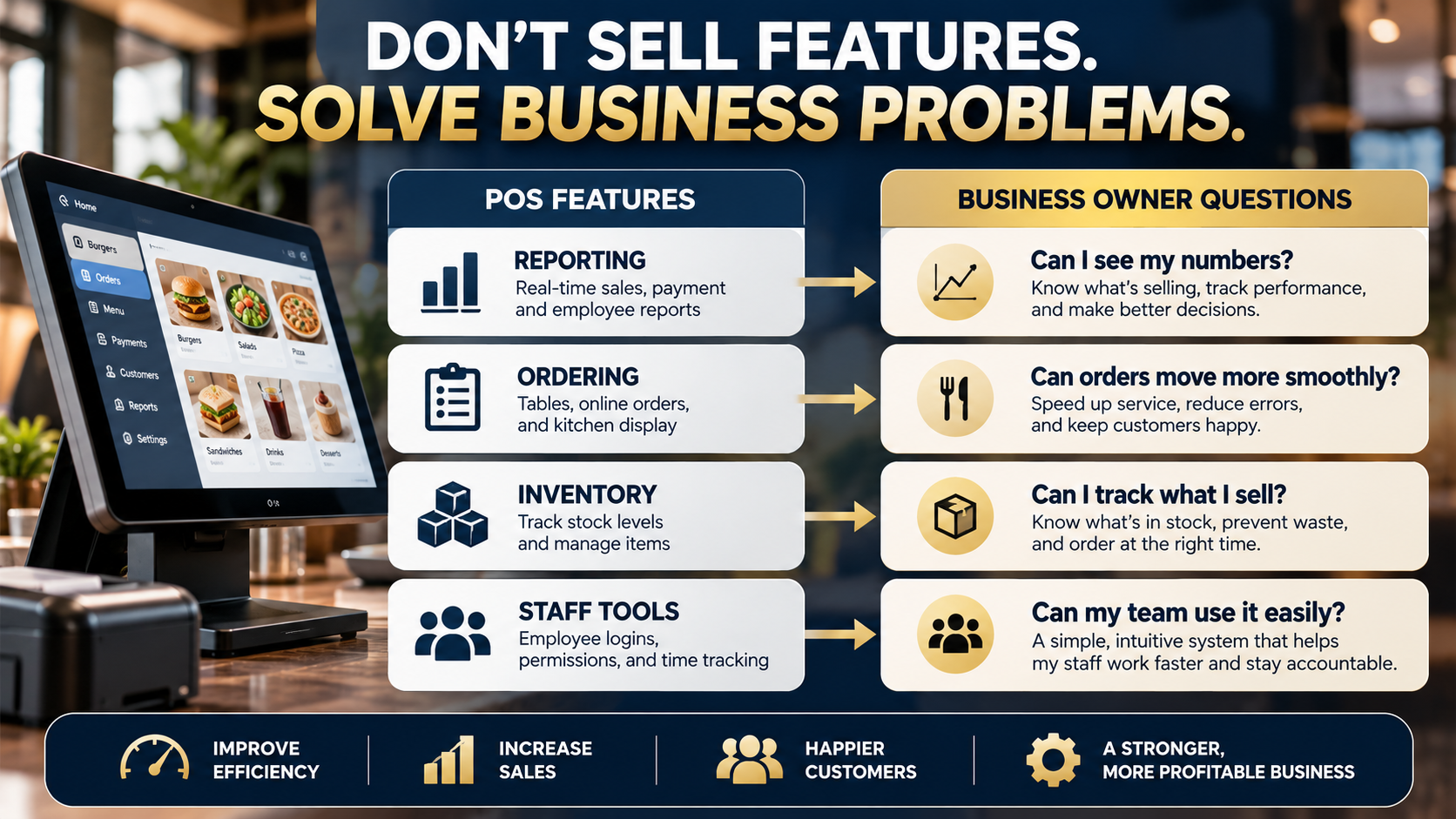
One of the biggest mistakes agents make when demonstrating technology is trying to show every feature.
They walk through dozens of screens.
They explain buttons, settings, reports, and technical details.
And after 45 minutes, the merchant is overwhelmed.
Here's what I want you to remember.
Business owners don't necessarily care how many features a system has. They care whether those features can improve their business.
If you're demonstrating a restaurant POS system, don't spend the entire meeting showing inventory tools if the owner's biggest concern is order accuracy and kitchen communication.
If you're working with a retailer, don't focus exclusively on online ordering when the merchant needs better inventory tracking.
Start with the problem.
Then demonstrate the relevant solution.
Example: A Restaurant Owner
Suppose the owner tells you:
"Our biggest problem is that orders get entered incorrectly, and the kitchen doesn't always receive them the way we need."
Your demonstration should focus on the relevant ordering and kitchen workflow capabilities of the system you're presenting.
Show the process.
Let the owner see how it works.
Ask whether that approach would fit their operation.
Example: A Retail Business
Suppose a retailer says:
"I can't easily see what's selling or keep track of inventory."
Your demonstration might focus on inventory management, product reporting, and other applicable tools.
But only if the proposed system actually supports those capabilities.
Example: A Service Business
Suppose a service business wants an easier way to manage payments, customer information, or transactions outside a traditional checkout counter.
You might demonstrate a system that supports those workflows.
Again, the goal is to show the merchant something relevant.
Not to impress them with a long list of features.
The Five Steps to an Effective POS Demonstration
I believe agents should approach POS demonstrations with the same discipline they bring to any important sales presentation.
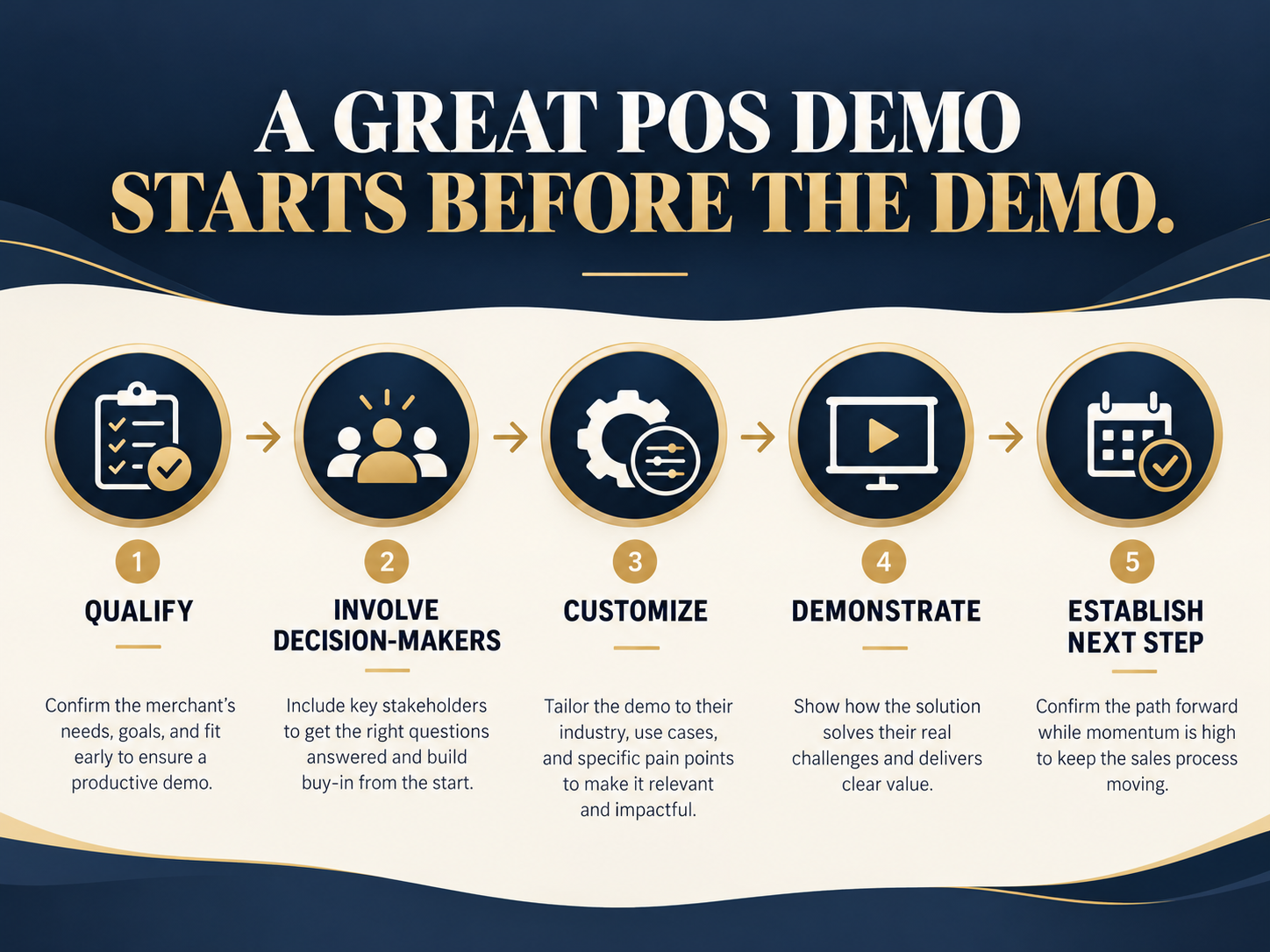
Here's a practical five-step process.
Step 1: Qualify the Opportunity Before Scheduling the Demo
Before you arrange a demonstration, understand why the merchant might consider changing systems.
Ask about their current setup.
Find out what's working and what isn't.
Understand their business type, locations, operational needs, and relevant integrations.
Determine whether the product you're recommending is a reasonable fit.
A demo is much more productive when you already know what the merchant wants to accomplish.
Step 2: Get the Right Decision-Makers Involved
This is extremely important.
If a restaurant has two owners who both need to approve a new system, try to involve both of them.
If the general manager will be responsible for using the software every day, their input may also matter.
You don't want to spend an hour demonstrating a system to someone who has no influence over the decision, only to learn that the actual owner needs to see everything again.
That doesn't mean every employee needs to attend.
It means understanding who should be involved.
Step 3: Customize the Demonstration Around the Business
Don't deliver the same generic demo to every merchant.
A full-service restaurant has different needs from a coffee shop.
A retailer has different needs from a salon.
And a multi-location operation may have different priorities from a single independent business.
Focus on the workflows that matter most to the prospect.
When possible, coordinate with a product specialist who understands the system thoroughly.
Step 4: Let the Merchant Participate
A demonstration should be interactive whenever practical.
Let the merchant ask questions.
Invite them to explore relevant workflows.
Encourage them to describe how their employees currently handle those tasks.
This helps them evaluate whether the solution fits their business.
And it helps you discover concerns that may not have surfaced during your initial conversation.
Step 5: Establish a Clear Next Step
Don't finish the demonstration by saying:
"Well, let me know what you think."
Instead, discuss what the merchant liked, what concerns remain, and what information they need to make a decision.
Maybe they need a formal proposal.
Maybe they want to compare software fees.
Maybe they need to review implementation requirements.
Maybe another decision-maker needs to participate.
Whatever the situation, establish a meaningful next step.
A successful demo doesn't always end with a signature. But it should end with clarity about where the opportunity stands.
You Don't Have to Be the Technical Expert
Here's something I want newer agents to understand.
You don't necessarily need to know every feature of every POS system to create a qualified demonstration opportunity.
You need to understand the merchant's needs.
You need to know enough about the products you represent to identify potential fits.
And you need to know when to involve someone with deeper technical expertise.
Many processing partners have product specialists, sales support teams, or demonstration resources that can assist with more complex technology presentations.
The level of support varies by provider, so make sure you understand what your partners actually offer.
If a merchant asks a technical question you can't answer, don't make something up.
Tell them you'll confirm the details.
Then follow through.
Your credibility is more valuable than pretending to know everything.
Your Role Is to Create and Manage the Opportunity
Think about your responsibilities as the sales agent.
You identify the business.
You establish the relationship.
You discover the need.
You qualify the opportunity.
You coordinate the demonstration.
You help the merchant evaluate the solution.
And you manage the sales process toward a decision.
That's a valuable role.
You don't need to become a software developer or POS technician.
But you do need to understand the solutions you're representing well enough to sell them responsibly.
Restaurants Can Be Excellent POS Opportunities
Restaurants are one of the most obvious markets for modern POS technology.
Think about everything a restaurant needs to manage.
Orders.
Payments.
Menus.
Employees.
Kitchen communication.
Reporting.
Online ordering.
Customer experiences.
And sometimes multiple locations.
A POS system can be central to many of those operations.
That means switching systems can be a significant business decision.
Why Restaurant Owners Need More Than a Rate Quote
A restaurant owner might save money on processing but still be unhappy if the replacement POS system creates operational problems.
That's why a complete evaluation matters.
You need to understand the merchant's current system and what they expect from a replacement.
Ask questions like:
What POS system are you currently using?
What do you like about it?
What frustrates you?
What are you paying for software?
Are there separate processing and technology charges?
What integrations do you rely on?
How would a system change affect your staff?
What support would you need during the transition?
Those questions help you identify whether there's a legitimate opportunity.
Understand the Full Cost of the Solution
When comparing restaurant POS systems, don't look only at payment-processing costs.
You may also need to evaluate:
Software subscription fees
Hardware costs
Installation charges
Support arrangements
Contract terms
Third-party integrations
Training requirements
Potential transition expenses
Different providers structure these costs differently.
Some may offer equipment promotions or reduced upfront hardware costs under specific conditions.
Others may charge separately for software, installation, or hardware.
Your job is to understand the actual offer and explain it accurately.
Don't promise free equipment, savings, or specific capabilities unless you've confirmed the terms for that merchant.
Why the Demonstration Is More Powerful Than a Brochure
Imagine you're considering buying a new vehicle.
Someone hands you a brochure explaining the features.
That's helpful.
But would you rather read about the vehicle or actually sit inside it and take a test drive?
For many buyers, experiencing the product makes a difference.
POS systems can be similar.
A brochure can explain features.
A website can show screenshots.
A video can provide an overview.
But a live demonstration gives the business owner an opportunity to see relevant workflows, ask questions, and evaluate how the system might fit their operation.
They can explore how an order is entered.
They can ask how a report is generated.
They can discuss what happens during a busy period.
They can raise concerns about employee training.
And you can address those questions before they make a decision.
A good POS demonstration helps turn an abstract product into something the merchant can evaluate in the context of their own business.
That's what makes demonstrations such an important sales activity.
Don't Confuse a Demo With a Guaranteed Deal
I want to be very clear about this.
Two POS demonstrations per week does not guarantee two signed accounts.
It doesn't guarantee one signed account.
And it doesn't guarantee a specific amount of commission or residual income.
The purpose of the benchmark is to create a measurable standard for developing qualified technology opportunities.
Some merchants will move forward.
Others won't.
Some may need additional meetings.
Some may discover the system isn't a good fit.
And that's okay.
A good sales process should help merchants make informed decisions, even when the decision is not to purchase.
Your job is to qualify opportunities, present appropriate solutions, and manage the process professionally.
The results will vary.
What Two POS Demonstrations Per Week Looks Like Over 90 Days
Let's look at the activity over approximately 13 weeks.
Time Period | Qualified POS Demos |
|---|---|
1 week | 2 |
4 weeks | 8 |
8 weeks | 16 |
13 weeks | 26 |
That's 26 qualified POS demonstrations in approximately 90 days.
Think about what that represents.
Twenty-six opportunities to show business owners technology that may improve how they operate.
Twenty-six opportunities to understand merchant needs.
Twenty-six opportunities to answer questions, present solutions, and potentially earn business.
Now compare that with an agent who conducts only one demonstration every month.
Over roughly three months, that agent might complete just three demos.
Again, the number of demonstrations doesn't guarantee the number of deals.
But consistent qualified demonstrations create more opportunities to evaluate and sell appropriate technology solutions.
And that's the reason for the benchmark.
Quality Still Matters
Don't schedule demonstrations simply to inflate your activity numbers.
If the merchant has no need for the system, no interest in evaluating it, or no realistic ability to make a decision, the opportunity may not be properly qualified.
You want demonstrations that have a legitimate business purpose.
The goal isn't to become great at scheduling demos. The goal is to become great at developing qualified opportunities.
Track Your POS Demo-to-Signed-Deal Conversion Rate
Just like proposals, POS demonstrations should be measured against actual outcomes.
One useful metric is your POS demo-to-signed-deal conversion rate.
For example, imagine two agents each conduct ten qualified POS demonstrations over a period of time.
Agent A signs four deals.
Agent B signs two.
Their results would look like this:
Measurement | Agent A | Agent B |
|---|---|---|
POS demonstrations | 10 | 10 |
Signed deals | 4 | 2 |
Demo-to-deal ratio | 40% | 20% |
These numbers are hypothetical examples, not expected industry conversion rates.
But they illustrate an important point.
Two agents can complete the same number of demonstrations and produce different results.
Why?
There could be several reasons.
One agent may be better at qualifying opportunities.
One may be demonstrating a more appropriate product.
One may involve the right decision-makers earlier.
One may be better at handling questions or coordinating follow-up.
Or the merchants may simply have different decision timelines.
The ratio gives you a reason to investigate.
It doesn't tell you everything by itself.
Measure Performance Over Time
POS opportunities can take longer to close than simpler processing deals.
Some involve software evaluations, multiple decision-makers, integration questions, and implementation planning.
That means you shouldn't judge your performance entirely by what happens in a single week.
Review trends over time.
Look at individual opportunities.
Consider the quality and complexity of the deals.
And use the information to improve.
For more on this, read my guide to merchant services KPIs and the sales numbers every agent should track.
How POS Demos Fit Into the Results Pyramid
One of the training frameworks I've used for years is my Results Pyramid.
It follows this progression:
Contacts → Owners → Full Pitches → Targets → Closes → Activations
The idea is simple.
Sales results depend on the activities that create and develop opportunities.
Prospecting helps you reach business owners.
Conversations help you identify needs.
Presentations, proposals, and demonstrations help merchants evaluate solutions.
Some of those opportunities eventually become signed deals.
And signed deals need to progress through approval and activation.
POS demonstrations fit into that process as an important way to develop qualified opportunities.
They're not necessarily required for every merchant-services deal.
And they don't always happen after a proposal.
The sequence depends on the merchant's needs.
But when technology is part of the opportunity, the demonstration can become a critical part of the decision-making process.
Watch My Results Pyramid Training
I've taught this concept for years because it helps agents understand why their activity matters.
Watch: How to Succeed in Merchant Sales — The Results Pyramid
The lesson is that you can't focus only on the final result.
You have to understand the process that creates it.
Common Mistakes That Hurt POS Demonstrations
Here are some of the biggest mistakes I want agents to avoid.
1. Scheduling Demos Without Qualifying the Merchant
Make sure there's a legitimate need and reason to evaluate the system.
2. Demonstrating Features That Don't Matter
Focus on the merchant's actual problems and priorities.
3. Leaving Out Decision-Makers
Understand who needs to approve the purchase and involve them when appropriate.
4. Making Claims You Haven't Verified
Don't promise integrations, capabilities, pricing, or implementation support without confirming the details.
5. Ignoring the Transition Process
A merchant may love the software but worry about switching systems.
Discuss installation, training, support, and other relevant transition considerations.
6. Failing to Discuss the Full Cost
Include relevant software, processing, hardware, and other costs when evaluating the solution.
7. Ending the Demo Without a Next Step
Determine what questions remain and what needs to happen next.
8. Stopping Prospecting Because You're Busy Running Demos
Don't let a few active technology opportunities replace the prospecting required to keep your pipeline healthy.
How POS Demos Fit Into a Healthy Merchant Sales Pipeline
A strong merchant-services pipeline needs new opportunities entering and qualified prospects moving toward decisions.
That's why I teach three core production activities.
Prospecting fills the pipeline.
Proposals help merchants evaluate recommended solutions.
POS demonstrations help merchants experience and evaluate technology.
All three can contribute to signed deals.
And signed deals still need to progress toward approval and activation.
You need to manage those opportunities carefully.
For example, after a demonstration, you should know:
Whether the merchant is interested in moving forward
What questions remain
Whether a formal proposal is needed
Whether other decision-makers need to be involved
Whether pricing or implementation details need clarification
When the next conversation should happen
That's why I recommend having a system for organizing merchant services leads, follow-ups, and deals.
You shouldn't have to rely on memory to remember what happened during a demonstration.
And you shouldn't lose an interested merchant simply because you forgot to follow up.
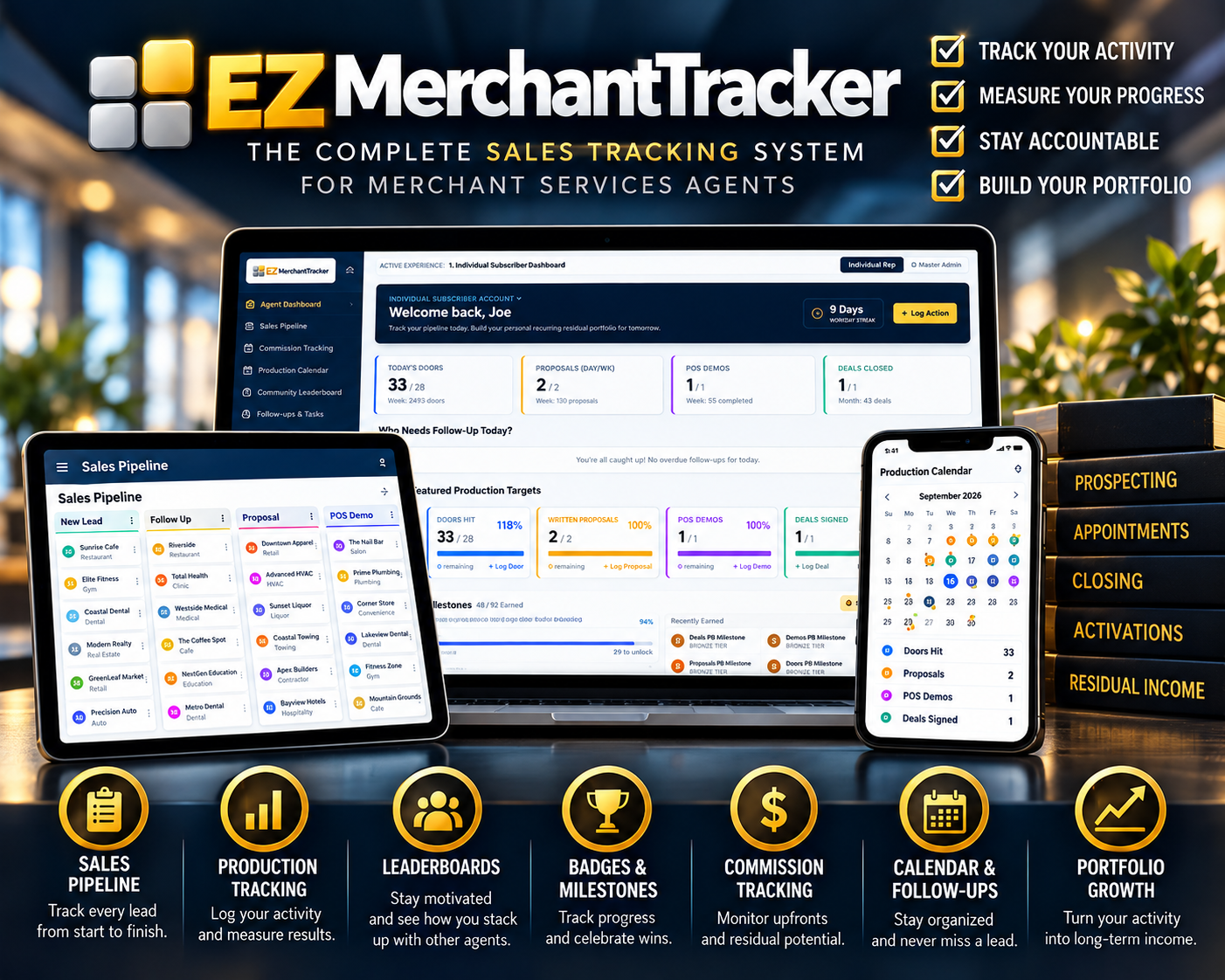
Why I Built POS Demo Tracking Into EZ MerchantTracker
When I created EZ MerchantTracker, I wanted agents to have a better way to understand the activities that create sales opportunities.
That's why I included POS demonstrations as one of the three core production measurements, alongside prospecting and proposals.
Agents can track their activity, compare it against recommended weekly benchmarks, and review how their production relates to signed deals.
But I want to emphasize something.
A CRM doesn't create the opportunity for you.
You still need to prospect.
You still need to identify merchant needs.
You still need to coordinate demonstrations.
And you still need to manage the sales process.
I built EZ MerchantTracker to help agents organize that work and understand their performance.
If you're interested in a CRM built specifically for merchant-services agents, you can try it free for 14 days.
Start Your 14-Day EZ MerchantTracker Trial
You can also watch my full EZ MerchantTracker demonstration.
The goal isn't to spend more time managing software.
It's to spend more time producing meaningful sales activity.
My Advice to New Merchant Services Agents
If you're new to the industry, don't be intimidated by POS technology.
You don't need to learn every system overnight.
Start with the products your processing partners actually offer.
Understand the types of merchants those systems are designed to serve.
Learn the most important features.
Understand the pricing and implementation requirements.
And find out what demonstration support is available through your partners.
Then start identifying businesses where those solutions may be a good fit.
If you're not confident enough to conduct a full demonstration yourself, ask an experienced product specialist to assist.
Watch how they present.
Pay attention to the questions business owners ask.
Learn how they connect the system's capabilities to the merchant's needs.
And keep improving.
That's how you develop confidence.
If you need a stronger foundation in merchant services and modern commerce systems, you can begin with the free education available through Merchant Service University.
The more you understand the solutions you're representing, the more valuable you can become to the businesses you serve.
Final Thought: Stop Competing Only on Rates and Start Creating Value
Here's what I want you to remember.
Merchant services isn't just about who can offer the lowest processing rate.
It's about helping businesses accept payments, operate efficiently, and choose solutions that fit their needs.
Sometimes that means reviewing processing costs.
Sometimes it means preparing a proposal.
And sometimes it means showing a business owner technology that could solve a problem they've been dealing with for years.
That's why I recommend two qualified POS demonstrations per week.
Not because two demos guarantee a certain number of signed deals.
But because consistently creating technology opportunities gives you another way to grow your business.
And when you combine those demonstrations with consistent prospecting and meaningful proposals, you're building a healthier sales pipeline.
Prospecting creates opportunities. Proposals present solutions. POS demos bring those solutions to life.
Then it's your job to follow through, earn the business, and help move signed deals toward activation.
That's the Merchant Sales Production Formula.
And it's one of the most important habits I believe merchant-services agents can develop.
Continue Learning: The Merchant Sales Production Formula
This article completes my four-part series on the three core activities that create merchant-services sales opportunities.
Part 1: The Production Formula
The Merchant Sales Production Formula: 3 Activities That Build a Healthy Pipeline
Part 2: Prospecting
Merchant Services Prospecting: Why Your Pipeline Dies When You Stop Finding New Business
Part 3: Proposals
Merchant Services Proposals: Why Presenting Solutions Is More Important Than Collecting Leads
For additional training, explore:
Merchant Services Sales Pipeline: How to Organize Leads, Follow-Ups, and Deals
Merchant Services KPIs: The Sales Numbers Every Agent Should Track
Sales Activity vs. Sales Results: What Merchant Services Agents Should Measure First
Frequently Asked Questions About POS Demos in Merchant Services
What is a POS demonstration in merchant services?
A POS demonstration is a presentation that allows a business owner to see how a point-of-sale system works and evaluate whether its features, workflows, and capabilities fit their business needs.
How many POS demos should a merchant services agent conduct per week?
I recommend working toward a minimum of two qualified POS demonstrations per week. This is a practical production benchmark I teach agents, not an industry-wide requirement or guaranteed closing formula.
Do POS demonstrations help merchant services agents close deals?
They can. Demonstrations allow merchants to evaluate technology, ask questions, and understand how a proposed system may address their business needs. Results depend on qualification, product fit, pricing, follow-up, and other factors.
Do I need to be a POS expert to sell POS systems?
You need a working understanding of the solutions you're representing, but you don't necessarily need to know every technical detail. Depending on your processing partner, product specialists or sales support teams may be available to assist with demonstrations.
What should I ask a merchant before scheduling a POS demo?
Ask about their current system, operational challenges, desired capabilities, decision-making process, relevant integrations, and timeline. This helps determine whether the proposed solution is a reasonable fit.
Should I demonstrate a POS system before or after presenting a proposal?
Either can make sense. Some merchants want to see the technology before reviewing a detailed proposal. Others prefer to understand pricing first. The order should reflect the merchant's needs and buying process.
What makes a POS demonstration effective?
An effective demo focuses on the merchant's actual business problems, involves appropriate decision-makers, shows relevant workflows, allows questions, and establishes clear next steps.
Are restaurant POS demos different from retail POS demos?
Often, yes. Restaurants may prioritize ordering, kitchen workflows, menus, and service operations, while retailers may focus on checkout, inventory, and reporting. The demonstration should reflect the specific business.
Do two POS demos per week guarantee merchant accounts?
No. Demonstrations create opportunities, but signed deals depend on merchant needs, product fit, pricing, competition, decision-making timelines, and sales execution.
Can EZ MerchantTracker help track POS demonstrations?
Yes. EZ MerchantTracker includes POS demo activity tracking, recommended weekly benchmarks, sales pipeline management, and related conversion measurements. You can try it free for 14 days.