
Merchant Services Prospecting: Build a Pipeline That Produces Deals
Merchant Services Prospecting: Why Your Pipeline Dies When You Stop Finding New Business
Want to build a successful merchant-services business? Stop waiting for your next deal and start creating your next opportunity.
After more than 16 years in merchant services, I can tell you that one of the biggest differences between agents who consistently build their portfolios and those who struggle isn't necessarily their ability to close.
It's their willingness to prospect.
I've seen agents who are fantastic in front of a business owner. They understand processing, know their products, can explain a proposal, and have no problem asking for the business.
But there's one problem.
They're not consistently putting themselves in front of new business owners.
Instead, they spend their time working the same few prospects, waiting for someone to call them back, or hoping their next referral will come through.
Then they wonder why their sales pipeline is empty.
You cannot consistently close deals if you're not consistently creating opportunities to close.
That's why prospecting is the first and most important activity in my Merchant Sales Production Formula.
And it's why I teach agents to treat prospecting as a nonnegotiable part of building a long-term merchant-services business.

Why Prospecting Is the Foundation of Every Merchant Services Business
Let's start with something simple.
Every merchant account in your portfolio started with a business owner.
At some point, you had to connect with that owner, introduce yourself, identify an opportunity, and begin a conversation.
Maybe you knocked on their door.
Maybe you called them.
Maybe someone referred you.
Maybe you met them through an existing business relationship.
The method can vary, but the principle doesn't.
New merchant accounts begin with new opportunities.
And prospecting is how you intentionally create those opportunities instead of waiting for them to appear.
This matters even more in merchant services because your business isn't built around a single transaction.
You're building a portfolio of merchant accounts that may generate recurring residual income as long as the merchants continue processing and your agreement provides for that compensation.
That means the work you do today can potentially contribute to your income for years.
But only if you consistently create new business.
If you're new to the industry, I recommend understanding how lifetime residuals in merchant services work before focusing exclusively on upfront commissions.
The opportunity is about building a portfolio over time.
And that portfolio starts with prospecting.
The Biggest Prospecting Mistake: Stopping When You Get Busy
Here's a pattern I've watched repeat itself throughout my career.
An agent starts prospecting aggressively.
They knock on doors, make calls, schedule appointments, and begin working with interested merchants.
Eventually, they close a few deals.
Now they're busy.
They have applications to complete, underwriting questions to answer, installations to coordinate, and merchants who need attention.
So they stop prospecting.
For a week.
Then another week.
Then a third.
Eventually, the accounts they're working on get activated, and their immediate workload slows down.
That's when they look at their pipeline and realize there's almost nothing new coming.
So they start prospecting again.
And the cycle repeats.
A few good weeks.
A few slow weeks.
Another burst of prospecting.
Another empty pipeline.
This is one of the biggest reasons merchant-services agents struggle with inconsistent production.
They prospect only when they need another deal.
Instead, I want agents prospecting because they're building a business.
There's a major difference.
My Recommended Prospecting Benchmark: 100 Business Doors Per Week
One of the production benchmarks I teach agents is a minimum of 100 business doors per week for an in-person prospecting model.
This isn't a magic number.
It's not an industry-wide rule.
And it certainly doesn't guarantee a specific number of signed merchant accounts.
It's a practical benchmark I created to help agents establish consistent prospecting habits.
Here's what it looks like over a standard five-day workweek.
Day | Business Visits |
|---|---|
Monday | 20 |
Tuesday | 20 |
Wednesday | 20 |
Thursday | 20 |
Friday | 20 |
Weekly total | 100 |
Twenty businesses per day is a manageable planning target for many territories, although actual capacity depends on travel distances, business density, appointment commitments, and the types of merchants you're visiting.
For agents who are able to dedicate more time to prospecting, I also teach higher-output daily activity models.
But if you're struggling with consistency, start by establishing a repeatable standard.
Don't make the mistake of setting an enormous goal on Monday and abandoning it by Wednesday.
Consistency matters more than an occasional burst of activity.
What Does 100 Doors Actually Mean?
I want to make an important distinction.
One hundred doors means 100 genuine business visits or prospecting attempts.
It does not mean 100 conversations with owners.
It does not mean 100 presentations.
And it doesn't mean 100 qualified opportunities.
Those are different measurements.
Some business owners won't be available.
Some businesses won't qualify.
Some merchants will have no interest.
Others may be worth revisiting.
The purpose of the benchmark is to make sure you're consistently creating opportunities to engage with new businesses.
What happens after the visit tells you how effectively you're prospecting.
Knocking on Doors Isn't the Goal. Talking to Decision-Makers Is.
I've seen agents get overly focused on their activity count.
They want to hit their 100 doors.
So they walk into businesses, drop off cards, say a few words to an employee, and move on.
At the end of the week, they proudly report their numbers.
But when I ask how many business owners they actually spoke with, they don't know.
That's a problem.
Because the goal of prospecting isn't simply to visit businesses.
The goal is to create meaningful conversations with people who can make decisions.
You need to know who you're speaking with.
You need to learn something about the business.
You need to identify whether there's a legitimate opportunity.
And when there is, you need to establish a next step.
What I Want Agents to Learn From a Business Visit
A productive prospecting conversation might help you determine:
Who owns or manages the business?
Who makes payment-processing and technology decisions?
What processing or POS system are they currently using?
Are they satisfied with their current setup?
Have they experienced problems with pricing, service, hardware, or software?
Is there a reason they might consider an alternative?
When would it make sense to continue the conversation?
You don't need to interrogate every business owner.
And you shouldn't turn a simple introduction into a 20-minute presentation when the merchant is clearly busy.
But you should approach the conversation with a purpose.
A good prospecting visit creates information, a relationship, or a possible next step.
That's what moves your business forward.
How I Recommend Approaching Business Owners
One of the biggest challenges for new agents is figuring out what to say when they walk into a business.
They worry about sounding inexperienced.
They think they need the perfect script.
They spend hours memorizing presentations.
And sometimes they use that preparation as an excuse to avoid actually getting started.
Here's my advice.
Keep your introduction simple.
Be professional.
Respect the business owner's time.
And don't begin with a complicated explanation of interchange rates, processor margins, or every product you represent.
Your initial objective is to start a conversation.
For example:
"Hi, my name is Joe. I work with local businesses on their payment processing and point-of-sale systems. Are you the owner, or is there someone here who handles those decisions?"
That's not a magical script.
It's simply a professional way to identify the right person and open a conversation.
Once you're speaking with the decision-maker, ask questions.
Find out what they're using.
Understand whether they have problems worth solving.
And determine whether there's a reason to continue.
The best prospecting conversations are about the merchant's business, not your sales pitch.
Don't Try to Close Every Merchant at the Front Door
Some opportunities move quickly.
You might meet an owner who's already frustrated with their processor and ready to evaluate alternatives.
That's great.
But other opportunities require time.
The merchant may need a statement analysis.
They may want a POS demonstration.
They may need to involve a partner.
They may simply need another conversation.
Your job is to recognize where the opportunity stands and take the appropriate next step.
That is why organizing your merchant services sales pipeline is so important.
If you can't remember what happened during your first conversation, you're making your second conversation unnecessarily difficult.
The Difference Between Prospecting and Following Up
I want agents to understand that prospecting and follow-up are related, but they're not the same activity.
Prospecting is the work of creating new sales opportunities.
Follow-up is the work of continuing conversations with existing opportunities.
Both are essential.
But they serve different purposes.
Imagine you have 40 businesses in your pipeline.
You spend Monday calling 15 of them.
You spend Tuesday visiting five merchants who asked you to return.
You spend Wednesday reviewing proposals.
Those activities may be productive.
But if you're not adding new opportunities, your pipeline can eventually shrink as deals close, prospects decline, or merchants stop responding.
That's why I teach agents to make room for both.
You need time to work the business you've already created.
And you need time to create the business you'll be working tomorrow.
A Healthy Weekly Routine Includes Both
A productive week might include:
New business prospecting
Scheduled follow-up visits
Processing statement reviews
Qualified proposals
POS demonstrations
Sales appointments
Signed applications
Installation or activation coordination
The exact schedule will vary.
But new prospecting shouldn't disappear just because you have existing opportunities.
Your pipeline needs new business entering while existing opportunities move forward.
That's how you build momentum.
Door-to-Door vs. Phone Prospecting: Two Ways to Build Your Pipeline
Not every merchant-services agent is going to prospect the same way.
I've taught two primary models throughout my sales training:
Door-to-door prospecting
Phone prospecting
Both can create legitimate opportunities.
The key is understanding how each model works and developing the discipline to execute it.
Door-to-Door Prospecting
Door-to-door prospecting allows you to meet local business owners in person.
You can observe the business, see how it operates, identify the payment technology it uses, and build relationships within your territory.
For many agents, this is an effective way to develop confidence and learn how to speak with business owners.
My recommended minimum benchmark for this model is 100 business visits per week.
But remember, the quality of your conversations matters.
You should also pay attention to how many decision-makers you're reaching and how many meaningful next steps you're creating.
Phone Prospecting
Phone prospecting allows agents to contact businesses without physically traveling between locations.
This can be especially useful for agents working remotely or pursuing opportunities outside their immediate area.
I've taught a dedicated phone model that can involve approximately 150 calls per day during focused calling days, commonly Monday through Wednesday.
The purpose of that activity is to create qualified conversations and scheduled appointments.
It's a different operating model from visiting 100 business doors each week.
You shouldn't combine the two benchmarks into an unrealistic daily workload.
Choose the model that fits your market, schedule, and selling strengths.
Then track the activity and results that matter for that model.
Watch: The Two Merchant Sales Models
I've created a training video explaining both approaches and how agents can use them to build their businesses.
Watch My Door-to-Door vs. Phone Prospecting Training
If you're planning to prospect by phone, I also have a walkthrough showing how to find free business leads for merchant services prospecting.
The important lesson is that both models require consistent execution.
Neither eliminates the need to engage with business owners.
Prospecting Should Lead to Proposals and POS Demonstrations
Now let's connect prospecting to the rest of the sales process.
I teach three core production activities:
Prospecting → Proposals and POS Demos → Opportunities for Signed Deals
This is the foundation of my Merchant Sales Production Formula.
My recommended weekly benchmarks for door-to-door agents are:
Activity | Weekly Benchmark |
|---|---|
Business doors | 100 |
Qualified proposals | 6 |
Qualified POS demonstrations | 2 |
These are activity goals, not a guaranteed conversion sequence.
A merchant might need a processing proposal without a POS demonstration.
Another might need to see a POS system before evaluating pricing.
Some opportunities involve both.
The purpose of these benchmarks is to keep agents focused on activities that create and develop real opportunities.
Why Prospecting Alone Isn't Enough
Let's say you visit 100 businesses this week.
You speak with several owners.
You collect a few statements.
You identify two restaurants interested in modern POS systems.
That's a good start.
But what happens next?
If you never prepare the proposals, schedule the demonstrations, or follow up, those visits may not lead anywhere.
Prospecting creates the opportunity.
The next activities help develop it.
That's why I don't want agents celebrating door counts while ignoring what those doors produce.
Your prospecting should feed your pipeline, and your pipeline should create opportunities to present solutions.
Why Proposals and Demos Depend on Prospecting
Now look at it from the opposite direction.
An agent tells me they want to complete six proposals this week.
Great.
But they haven't been talking to new merchants.
Where are those proposals going to come from?
Another agent wants to run two POS demonstrations.
But they haven't identified any businesses interested in evaluating new technology.
Where are the demonstrations going to come from?
That's the point.
The later activities depend on having enough qualified opportunities.
Consistent prospecting creates the pool of potential merchants from which proposals and demonstrations can develop.

The Results Pyramid: Understanding What Prospecting Actually Produces
One of the training frameworks I've used for years is my Results Pyramid.
It illustrates how sales activity develops into actual business.
The progression is:
Contacts → Owners → Full Pitches → Targets → Closes → Activations
Each stage gives you a different measurement.
You might contact 100 businesses but speak with only a portion of the owners.
Of those owners, some may be willing to hear a full presentation.
A smaller group may become qualified opportunities.
Some of those opportunities may eventually close.
And signed deals still need to progress toward activation.
The exact conversion rates will vary.
But the principle remains the same.
The results at the top of your sales process depend on what you're doing at the beginning.
If you're not creating enough opportunities to speak with owners, you may struggle to produce the proposals, demos, and closes you're looking for.
Watch My Results Pyramid Training
In this video, I explain the relationship between prospecting activity and merchant-sales results.
How to Succeed in Merchant Sales — The Results Pyramid
It's a valuable lesson for agents who want to understand why consistent activity matters.
The Numbers Behind 90 Days of Consistent Prospecting
Let's look at what happens when an agent consistently meets the 100-door weekly benchmark.
Over approximately 13 weeks:
Time Period | Business Visits |
|---|---|
1 week | 100 |
4 weeks | 400 |
8 weeks | 800 |
13 weeks | 1,300 |
That's 1,300 business visits in approximately 90 days.
Now compare that with an agent who averages only 20 business visits per week.
Over the same 13 weeks, that agent would complete 260 visits.
The difference is 1,040 additional prospecting attempts.
That doesn't mean the higher-activity agent is guaranteed to close more deals.
Territory quality, sales skill, decision-maker access, qualification, competition, and follow-up all matter.
But the higher-activity agent is creating substantially more opportunities to engage with businesses.
And if those visits are being conducted professionally, tracked accurately, and supported by meaningful follow-up, that can make a major difference in the number of sales opportunities available.
Don't Confuse the Activity Benchmark With a Sales Guarantee
I want to emphasize something.
There is no universal formula that says 100 doors equals a certain number of merchant accounts.
Some territories are more competitive than others.
Some agents are more experienced.
Some business owners are easier to reach.
Some sales cycles take longer.
That's why I want agents to track both activity and results.
Your prospecting count tells you how much work you're putting into creating opportunities.
Your conversion rates help you understand what those opportunities are producing.
You need both.
How to Know Whether Your Prospecting Is Actually Working
If you're consistently prospecting but not creating opportunities, don't immediately assume you need to work harder.
You may need to work differently.
Start asking yourself some questions.
Are You Reaching Decision-Makers?
If you're visiting plenty of businesses but rarely speaking with owners, you may need to change the times you're prospecting or improve how you identify the decision-maker.
Are You Having Meaningful Conversations?
If you're reaching owners but immediately getting dismissed, evaluate your introduction and how you're starting the conversation.
Are you making it about their business or launching into a generic sales pitch?
Are You Identifying Real Opportunities?
If business owners are willing to talk but nobody wants a proposal or demonstration, you may need to improve your qualification and discovery process.
Are You Establishing Next Steps?
If you have plenty of interested prospects but they never progress, look at your follow-up habits.
Are you scheduling specific next actions?
Or are you simply hoping the merchant remembers you?
Are You Tracking Your Results?
If you can't answer these questions with any confidence, that's another problem.
You need enough information to understand where your sales process may be breaking down.
I explain this further in my article on merchant services KPIs and the numbers every agent should track.
The goal isn't to turn sales into complicated mathematics.
It's to make sure you're learning from your work.
Protect Your Production Hours
One of the most important habits I teach agents is to protect the hours when business owners are available.
For many types of businesses, that might be roughly 9 a.m. to 5 p.m.
For others, it could be earlier or later.
Restaurants, for example, often have different operating patterns from traditional offices.
The point isn't that every agent must prospect during the same exact hours.
The point is to identify the hours when you're most likely to reach decision-makers and use them wisely.
What Shouldn't Replace Your Prospecting Time?
I see agents spend valuable selling hours doing things like:
Redesigning their website
Creating new business cards
Updating social media profiles
Rewriting sales scripts
Organizing training materials
Researching products they don't currently need
Watching hours of sales videos without applying anything
Those activities may have a place in your business.
But they shouldn't consistently replace conversations with potential clients.
If you're serious about building a merchant portfolio, prioritize the activities that can actually create business.
Do your administrative work before or after your most productive selling hours whenever practical.
Your CRM Shouldn't Become Another Distraction
This applies to organizing your pipeline, too.
A CRM is supposed to help you sell.
It shouldn't become a place where you spend two hours rearranging leads to avoid making calls.
Review your priorities.
Record important information.
Schedule follow-ups.
Then get back to engaging with business owners.
The purpose of organization is better execution, not endless administration.
What to Do When You're Having a Bad Prospecting Week
Every agent is going to have difficult weeks.
Business owners are unavailable.
People tell you no.
Appointments cancel.
Prospects stop responding.
That's part of sales.
But here's where discipline becomes important.
If you allow every difficult day to determine whether you prospect tomorrow, you'll struggle to build consistency.
Instead, focus on the actions you can control.
You can prepare your territory.
You can improve your introduction.
You can follow through on appointments.
You can review what worked.
You can ask for coaching.
And you can show up again.
Don't Judge Your Entire Business by One Day
A day without a qualified opportunity doesn't necessarily mean your approach is failing.
And one great day doesn't mean you've mastered prospecting.
Look at your results over meaningful periods of time.
Review your activity weekly.
Evaluate your conversations.
Identify patterns.
Then make adjustments.
That's how you develop as a salesperson.
Learn to Separate Rejection From Your Identity
When a business owner says no, they're not necessarily rejecting you as a person.
They may be happy with their current provider.
They may not need your solution.
They may have had a bad experience with another salesperson.
Or the timing may simply be wrong.
You don't have to win every conversation.
You need to remain professional, learn from your experiences, and keep creating opportunities.
How I Recommend New Agents Structure Their Prospecting Week
If you're just starting in merchant services, keep your routine simple.
Here's an example for an agent using the 100-door weekly model.
Monday: Start Strong
Begin with new business prospecting and handle scheduled follow-ups.
Don't spend the entire morning organizing your week.
Get into the field.
Tuesday: Build Momentum
Continue prospecting and advance opportunities created on Monday.
Prepare proposals or schedule demonstrations when legitimate opportunities arise.
Wednesday: Review Your Progress
Check whether you're on pace toward your weekly prospecting benchmark.
Look at your qualified conversations, proposals, and demonstrations.
Adjust your remaining schedule if necessary.
Thursday: Keep Producing
Continue visiting new businesses while following through on scheduled appointments and merchant opportunities.
Don't stop prospecting just because Friday is approaching.
Friday: Finish and Review
Complete your remaining prospecting activity.
Follow up with important opportunities.
Review what you accomplished and what needs attention next week.
A healthy routine balances new prospecting with the work required to move existing opportunities forward.
It shouldn't be so rigid that you miss an important merchant meeting simply to hit a door count.
But it should be consistent enough that prospecting doesn't disappear whenever something else comes up.
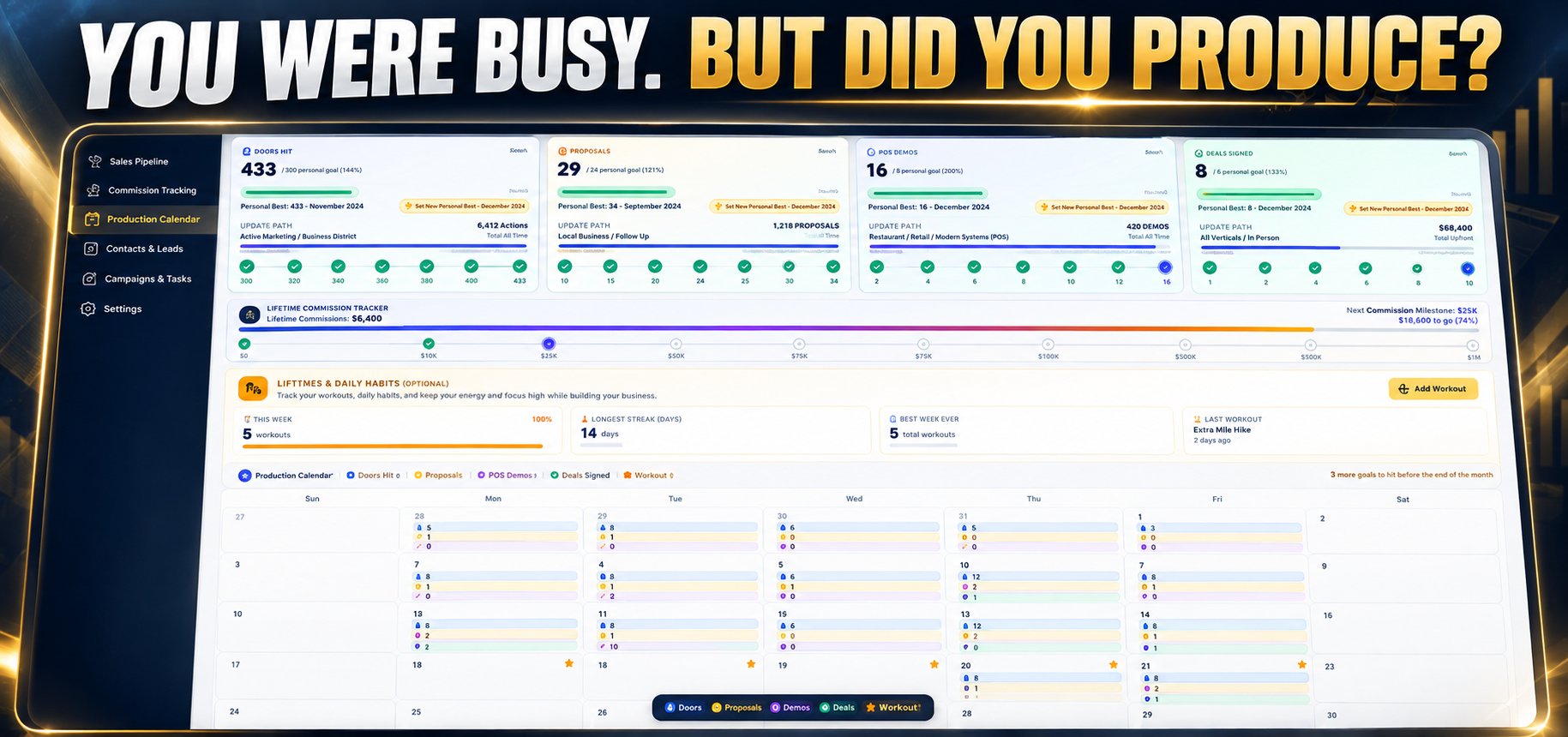
Why I Built Prospecting Activity Tracking Into EZ MerchantTracker
Prospecting is so important to building a merchant-sales business that I made it one of the core production activities agents can track inside EZ MerchantTracker.
Along with proposals and POS demonstrations, agents can record their activity and compare their performance against recommended weekly benchmarks.
But I want to be clear.
You don't need expensive software to start tracking your prospecting.
You can use a notebook.
You can use a spreadsheet.
You can keep a simple daily scorecard.
What matters is knowing whether you're consistently doing the work.
I created EZ MerchantTracker because I wanted agents to have one place to manage their pipeline, track production, organize follow-ups, and review their results.
If you're looking for a merchant-services CRM built around the way agents actually sell, you can explore it with a 14-day free trial.
Start Your 14-Day Free EZ MerchantTracker Trial
And if you'd like to see how it works before signing up, watch my complete software demonstration.
Remember, though: the software doesn't do the prospecting for you.
That's still your job.
Prospecting Today Can Become Residual Income Tomorrow
One of the reasons I love merchant services is that the work you do today can potentially continue generating income long after the original sale.
When you sign a merchant account and that business continues processing, you may receive recurring residual compensation according to your agent agreement.
That creates a different opportunity from sales positions where you get paid once and have to start over.
But the recurring-income potential doesn't eliminate the need for active work.
In fact, it makes consistent prospecting even more important.
You're not simply looking for your next commission.
You're building a portfolio.
And every new qualified opportunity represents a potential addition to that portfolio.
I've explained the difference between one-time commissions and recurring residual income in more detail.
The important thing to remember is that residual income isn't guaranteed, and merchant retention, processing volume, pricing, and contract terms all affect the outcome.
But the business model gives you a reason to think beyond the next sale.
Today's prospecting can become tomorrow's portfolio growth.
Final Thought: Never Let Your Pipeline Depend on Hope
If there's one lesson I want you to take away from this article, it's this:
Don't wait until your pipeline is empty to start prospecting.
Don't wait until you have a bad sales month.
Don't wait until your last proposal falls through.
And don't wait until you're desperate for another deal.
Build prospecting into your weekly routine.
For door-to-door agents, start with the 100-door benchmark.
For phone-based agents, establish a dedicated calling model and measure the conversations and appointments it produces.
Track your activity.
Improve your conversations.
Work your follow-ups.
Create proposals and POS demonstrations when the opportunity is right.
And keep moving forward.
Because your future residual portfolio isn't built by the deals you're hoping to close.
It's built through the consistent actions you take to create new opportunities.
That's why prospecting is the foundation of the Merchant Sales Production Formula.
And it's why I believe every serious merchant-services agent should treat it as a core business responsibility.
Continue Learning: The Merchant Sales Production Formula
This article is part two of my four-part training series on the activities that create merchant-services sales opportunities.
Start with the cornerstone article:
The Merchant Sales Production Formula: 3 Activities That Build a Healthy Pipeline
Next in the series:
Merchant Services Proposals: Why Presenting Solutions Is More Important Than Collecting Leads
Planned URL: https://iamjoewagner.com/post/merchant-services-proposals
Coming after that:
POS Demos in Merchant Services: Why Showing Business Owners the Technology Creates Opportunities
Planned URL: https://iamjoewagner.com/post/merchant-services-pos-demos
For additional training, you can also explore:
Merchant Services Sales Pipeline: How to Organize Leads, Follow-Ups, and Deals
Sales Activity vs. Sales Results: What Merchant Services Agents Should Measure First
If you're brand new to merchant services, start with the free education available through Merchant Service University.
Frequently Asked Questions About Merchant Services Prospecting
What is merchant services prospecting?
Merchant services prospecting is the process of identifying and contacting business owners who may benefit from payment processing, POS systems, or other commerce solutions. It can include door-to-door visits, phone calls, referrals, networking, and other legitimate business-development methods.
How many doors should a merchant services agent knock per day?
I recommend a weekly benchmark of 100 business visits for door-to-door agents, which averages 20 visits per day over five working days. This is a practical production target, not a guaranteed formula for closing merchant accounts.
Is door-to-door prospecting still effective for merchant services?
It can be. Visiting businesses in person allows agents to meet decision-makers, observe business operations, and identify potential opportunities. Results depend on territory, timing, approach, qualification, and follow-up.
Can I sell merchant services over the phone instead?
Yes. Phone prospecting is another model I teach. Agents can use business lead lists to contact owners, qualify opportunities, and schedule appointments. The appropriate call volume and results will depend on the agent's strategy, market, and execution.
What's the difference between prospecting and follow-up?
Prospecting focuses on creating new opportunities, while follow-up focuses on advancing conversations with businesses already in your pipeline. Both are necessary for maintaining consistent sales production.
How do I turn merchant services prospecting into actual deals?
Focus on reaching decision-makers, understanding merchant needs, identifying legitimate opportunities, and establishing meaningful next steps. Those conversations may lead to proposals, POS demonstrations, appointments, and eventually signed deals.
Why is my merchant services pipeline empty even though I'm busy?
You may be spending too much time on administrative work, existing opportunities, or activities that don't generate new prospects. Review how much time you're dedicating to new business development and whether those efforts are creating qualified conversations.
What should I track when prospecting for merchant services?
At minimum, track your prospecting attempts, meaningful conversations, qualified opportunities, and follow-up actions. You should also measure how your activity relates to proposals, POS demonstrations, and signed deals over time.
Do 100 business visits guarantee merchant services sales?
No. The 100-door benchmark measures prospecting activity. Actual sales results depend on decision-maker access, merchant needs, sales ability, qualification, follow-up, competition, and other factors.
How can EZ MerchantTracker help with prospecting?
EZ MerchantTracker helps merchant-services agents organize leads, manage follow-ups, track business visits, and review sales activity alongside proposals, POS demonstrations, and signed deals. You can try it free for 14 days.