
Merchant Services Training for Beginners: Start Here
Merchant Services Training for Beginners: Get Educated Before You Get Recruited
If you're looking for merchant services training for beginners, the first thing I would tell you is simple:
Do not start by asking which company you should join.
Start by learning how the industry works.
That order matters because the merchant-services industry has a recruiting problem.
A new person becomes interested in payment processing, searches for an opportunity and immediately lands on a company's recruiting page. The company naturally teaches them why its products are great, why its compensation is attractive and why they should sign up.
But the beginner still doesn't know enough to evaluate what they're being told.
They don't understand residuals.
They don't know what a Schedule A is.
They don't understand vesting.
They don't know whether a 50% residual split is good.
They don't know what happens if they stop selling.
They don't know how merchant pricing works.
They don't know the difference between a sales agent and a registered ISO.
They haven't learned enough about the industry to determine whether the opportunity in front of them actually fits what they want to build.
That is why my philosophy is:
Get educated before you get recruited.
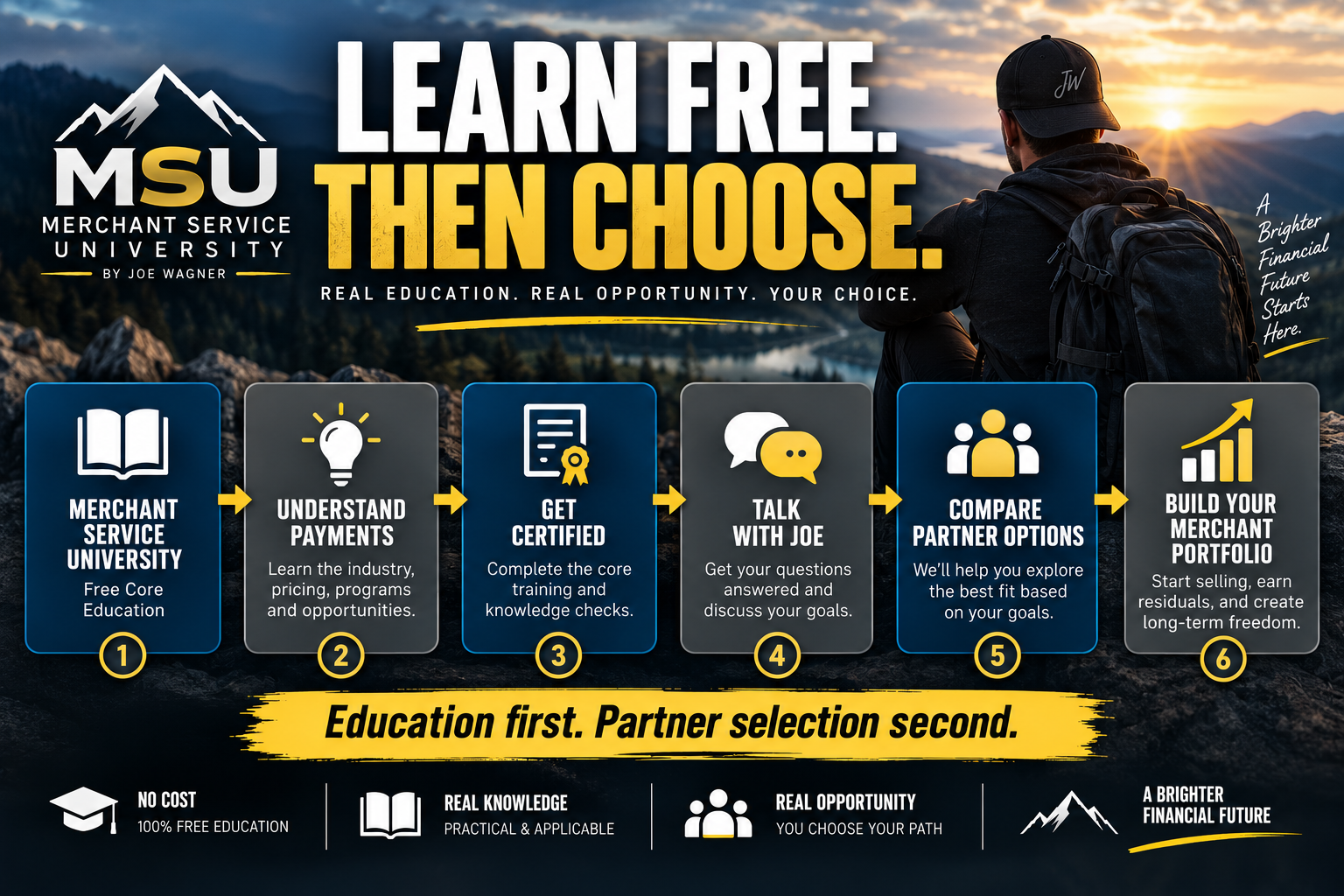
I created Merchant Service University specifically to give beginners that educational starting point. The core training is free, and you do not have to commit to one processing company simply to learn how the business works.
Learn first.
Then decide.
Why Beginners Are Easy to Recruit
When you don't understand an industry, almost every opportunity sounds good.
Someone tells you:
"We pay lifetime residuals."
Great.
What does lifetime mean in the agreement?
Someone tells you:
"You'll receive 60%."
Great.
Sixty percent of what?
Someone tells you:
"We have the lowest rates."
Compared with what pricing model?
Someone tells you:
"You'll own your portfolio."
What does the contract say about vesting, termination and transfer rights?
Someone tells you:
"You don't need to worry about the Schedule A."
That's probably the exact moment you should learn what a Schedule A is.
None of this automatically means the recruiter is misleading you.
The recruiter may work for a great company.
The problem is that you don't yet have the knowledge necessary to know the difference.
Education creates leverage because it allows you to ask better questions.
Beginner Training Should Teach the Industry Before the Opportunity
The first thing a new merchant-services agent should learn is not a script.
It is the structure of the business.
You should understand who the merchant is, who the cardholder is, what the processor does, what an acquiring bank does, what the issuing bank does, where the card networks fit and where the sales organization fits.
You should understand enough about the payment journey to explain what happens when a customer presents a card and how the merchant eventually receives the funds.
You don't need to become a payment-processing engineer.
You need enough foundational knowledge that the words being used around you actually mean something.
If you're starting at zero, read my Complete Beginner's Guide to Merchant Services Sales and How Credit Card Processing Works for Sales Agents.
Those two topics should come before almost everything else.
Then Learn How Merchant Services Agents Actually Get Paid
Compensation is one of the things that attracts people to this industry.
It is also one of the easiest areas for a beginner to misunderstand.
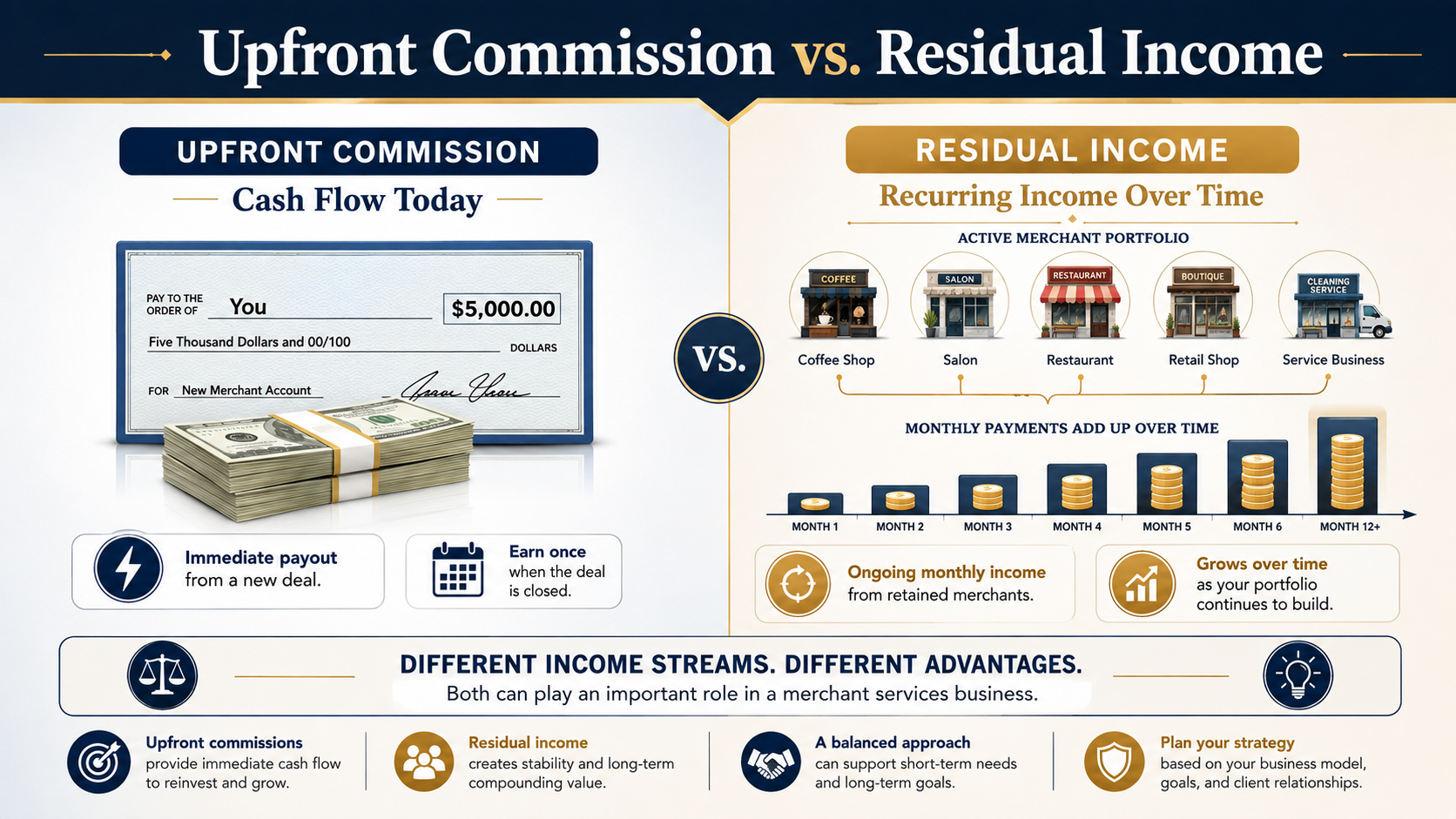
Merchant-services agents may receive upfront commissions, recurring residual income or a combination of both depending on the program.
But hearing the word residual is not enough.
You need to understand how the residual is calculated.
Suppose you're offered a 50% split.
That does not necessarily mean you receive half of every dollar the merchant pays.
The residual calculation generally depends on the eligible profit remaining after the applicable underlying costs defined by the program.
That's why a clean 50% arrangement can sometimes generate more actual income than a 60% arrangement with more expensive underlying costs.
I've broken this down in detail in Merchant Services Residual Splits Explained.
You should also understand upfront commissions versus residual income, because different partner programs may emphasize different compensation models.
This is one of the areas where I help agents after they become educated.
One salesperson may tell me they are focused heavily on building long-term recurring income.
Another may be an experienced closer who wants strong upfront compensation. One of the partners I work with can pay up to $10,000 upfront on certain qualified merchant deals based on profitability and program terms.
Another partner may offer different advantages that matter more to someone else.
The point is not that one company is automatically best.
The point is that you should understand compensation well enough to identify what is most important to you.
Learn What a Schedule A Is Before Someone Shows You One
A Schedule A sounds complicated when you're brand new.
It isn't.
Think of it as part of the economic framework underneath your residual compensation.
It may include transaction costs, monthly costs, statement expenses, BIN or sponsorship-related costs and other program-specific items.
Those costs affect how much eligible profit is left before your residual percentage is applied.
You don't need to spend three weeks comparing every penny between five companies.
You do need to understand that Schedule A costs are not all created equal.
A two-cent difference in transaction cost can become meaningful across thousands of monthly transactions.
A five-dollar monthly cost can become meaningful across a portfolio of 100 merchants.
And if you waive a merchant-facing fee while still carrying an underlying cost yourself, you can reduce the profitability of the account without realizing it.
I explain this with real examples in Merchant Services Schedule A Explained.
Beginners don't need to become accountants.
They need enough knowledge that a compensation plan cannot hide behind percentages.
Understand the Agent Agreement Before Signing It
This is another place where education should happen before recruitment.
An agent agreement can govern your residuals, vesting, termination rights, production expectations, non-solicitation provisions, clawbacks and other parts of the business relationship.
Most new agents focus on the part that tells them what they get paid.
Experienced agents tend to care much more about the sections explaining what can happen to that income later.
Does your residual continue if you stop actively producing?
What happens if you resign?
What happens if the company terminates the relationship?
Are there production requirements?
Can the Schedule A change?
What does the agreement say about merchants you've already placed?
Can residual compensation be offset against other losses?
None of those questions make you difficult.
They make you informed.
Use my 11 Questions to Ask Before Signing a Merchant Services Agent Agreement and Merchant Services Contract Red Flags as a starting point.
They are educational resources, not a substitute for legal advice on your specific agreement.
Learn What "Lifetime Residuals" Really Means
This phrase deserves its own section because beginners love it.
I love residual income too.
It is one of the biggest reasons I believe merchant services is such an attractive sales industry.
But lifetime residuals do not mean guaranteed money forever.
A merchant has to remain active.
The account has to continue producing eligible revenue.
Your contractual rights need to remain intact.
The merchant may eventually close, sell, switch providers or stop processing.
The agreement may contain rules affecting how residuals survive after termination.
That's why I prefer teaching beginners to think in terms of recurring portfolio income instead of imagining money magically showing up forever.
The opportunity is powerful enough without exaggerating it.
Read What Lifetime Residuals Really Mean in Merchant Services before allowing the word "lifetime" to influence your decision.
Training Should Also Teach You What Merchants Actually Need
A beginner can learn all the industry terminology and still fail if they don't understand merchants.
Your job is not to walk into every business and sell the same product.
Different businesses have different problems.
A contractor may need invoicing and simple payment acceptance.
A salon may care about appointments and customer management.
A retailer may need inventory.
A restaurant may need specialized point-of-sale technology.
An online business may care more about e-commerce and remote payment acceptance.
And some small businesses simply want a dependable standalone terminal and a fair processing arrangement.
Good merchant-services training teaches you to diagnose the business before presenting the solution.
The question should not be:
"How do I convince this merchant to buy what I sell?"
It should be:
"What does this merchant actually need?"
That mindset will keep you from becoming the salesperson who walks into every business with the same pitch.
Learn Prospecting Early, Because This Is Still a Sales Business
Education is important.
But education can also become an excuse.
At some point you need to talk to merchants.
The hardest part of becoming a merchant-services salesperson is often not understanding processing.
It's consistently prospecting.
You need to build lists.
Make calls.
Walk into businesses.
Create referrals.
Book appointments.
Follow up.
Have conversations.
A beginner can spend weeks researching the perfect processor while avoiding the uncomfortable part of the business.
Don't do that.
Learn enough to begin responsibly.
Then start gaining experience.
Your real education accelerates when merchants begin asking questions you didn't know you needed to learn.
Don't Buy a Huge Tech Stack Before You Can Sell
One of the things I see entrepreneurs do constantly is build the business infrastructure before they build the business.
They buy a CRM.
Then a dialer.
Then automated email.
Then lead software.
Then a website.
Then another tool.
Meanwhile, they still haven't spoken to ten merchants.
You don't need all of that to start.
Your first system can be extremely simple:
Who are you contacting?
When are you contacting them?
What happened?
When are you following up?
That's enough to begin.
As I explained in Can You Start Selling Merchant Services for Free?, I would rather see a beginner start lean, create activity and then spend money when they understand what actual bottleneck they're trying to solve.
You Do Not Need to Become a Registered ISO to Start
This is another misconception beginners encounter.
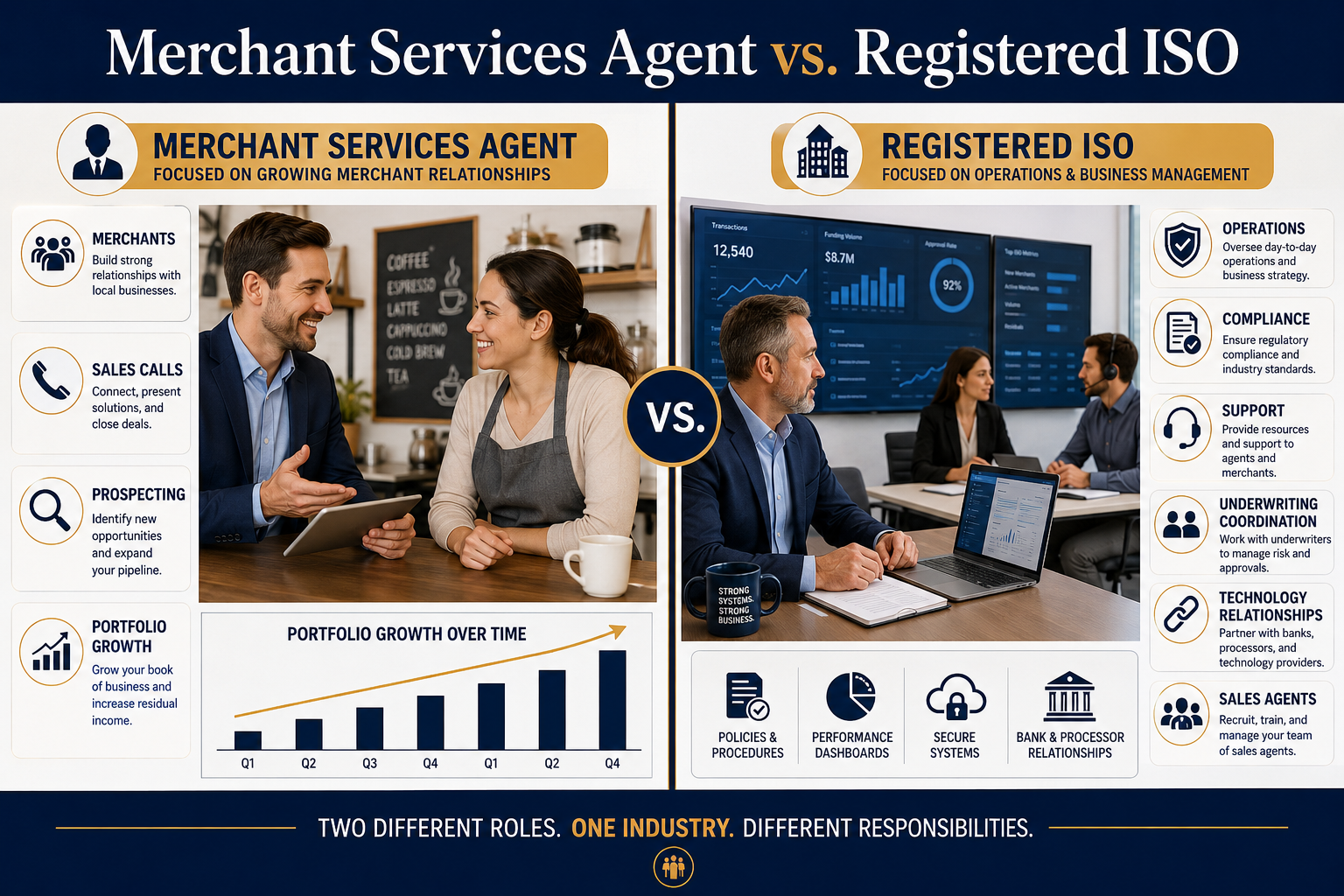
You do not have to build a payment-processing company from the ground up in order to build a business in merchant services.
Most new salespeople are better served working through an established backend organization.
The ISO or processing partner can handle areas such as underwriting infrastructure, merchant support, risk, equipment deployment, product relationships and residual reporting.
You concentrate on acquiring merchants and building relationships.
I explain why I think becoming a registered ISO is overrated for most sales-focused entrepreneurs in Merchant Services Agent vs. ISO.
You can build a very real business without trying to own every piece of the payment infrastructure.
The Company Is a Tool, Not Your Identity
This is an important mindset shift.
New agents often become emotionally attached to the first company that recruits them.
They start talking as though the company's brand is their business.
I think that's backwards.
Your business is the merchant relationships you build, the expertise you develop, the reputation you create and the portfolio you accumulate.
The processing company is one of the tools that helps you serve those merchants.
That doesn't mean partnerships aren't important.
They are incredibly important.
But the objective is not to become a walking billboard for one processor.
The objective is to become someone who understands enough about payments to put merchants into solutions that make sense.
That perspective also makes it easier to evaluate partner companies rationally.
How I Would Train a Beginner Today
If you came to me with no merchant-services experience, I would not start by handing you a processing application.
I would first make sure you understand:
How the industry works.
Then:
How transactions work.
Then:
How merchants are priced.
Then:
How statements work.
Then:
How agents get paid.
Then:
How residuals, Schedule A economics and agreements work.
Then:
How modern commerce technology fits different businesses.
Then:
How to prospect, run discovery, present solutions, close, onboard and retain merchants.
That sequence gives the sales training context.
It is the same philosophy behind the larger curriculum I outlined in Merchant Services Training: What Every New Agent Should Learn Before Selling.

Why Merchant Service University Comes Before Partner Matching
This is the core of how I've chosen to structure my business.
I work with multiple merchant-services partner companies.
Different partners make sense for different people.
One may have stronger upfront compensation.
Another may be better for someone focused primarily on recurring residual income.
Another may have specific technology, underwriting options, support or merchant solutions that fit a particular sales strategy better.
But I don't want the first interaction to be:
"Here is the company I want you to join."
I want the first interaction to be:
"Here is the industry you need to understand."
That's what Merchant Service University is for.
The core education is free.
There is no obligation to join one specific partner.
You go through the fundamentals.
You learn the terminology.
You understand what questions to ask.
Then, if you want help exploring potential merchant-services partners, we can talk about your goals.
Maybe your number-one priority is large upfront compensation.
Maybe it's lifetime residual rights.
Maybe it's merchant support.
Maybe it's technology.
Maybe it's underwriting.
Maybe you aren't even sure yet.
That's okay.
The education helps you figure it out.
The Beginner Path: Learn → Get Certified → Decide
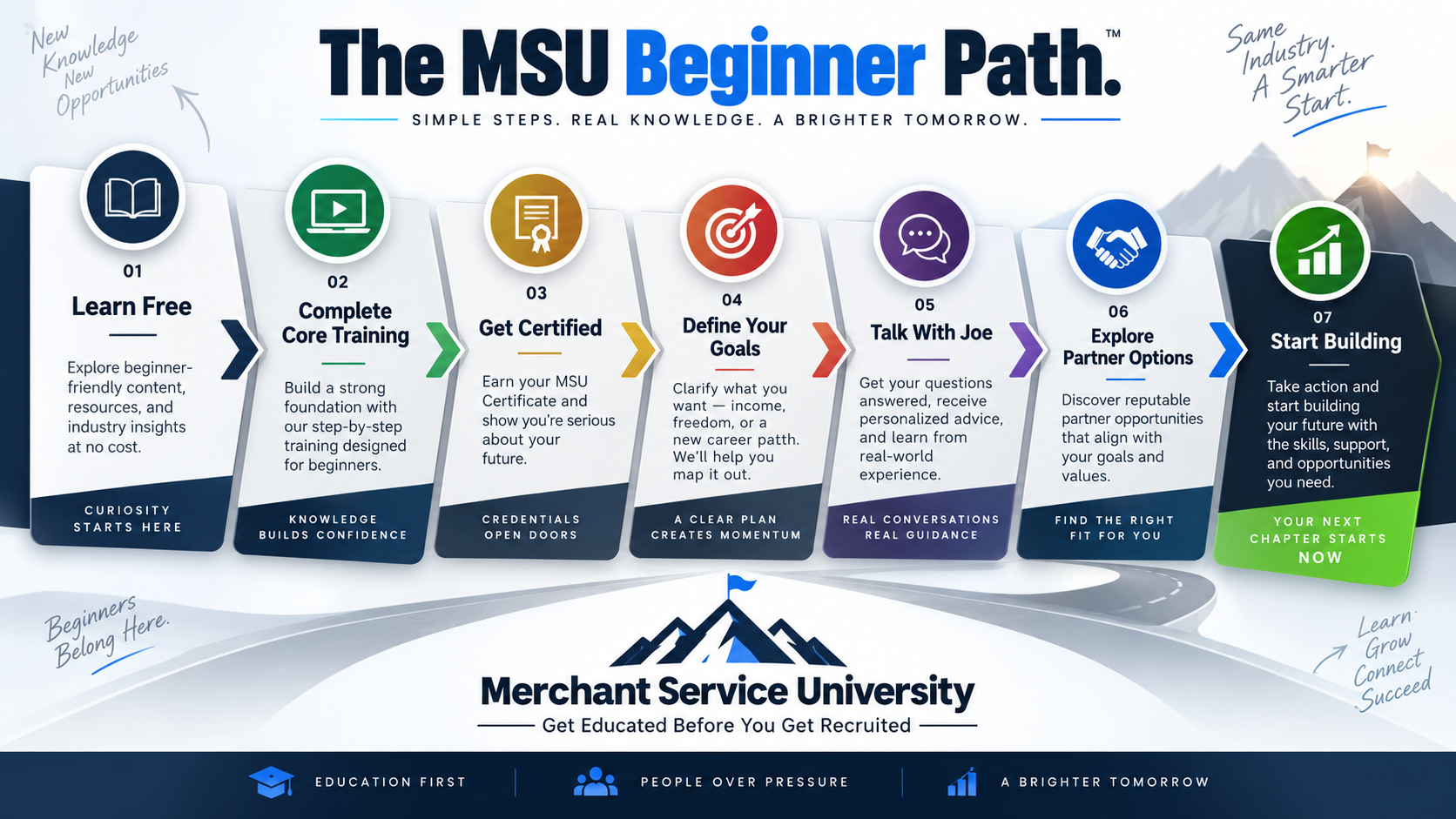
I believe the cleanest path into merchant services looks like this:
Step 1: Learn the fundamentals.
Understand the industry before signing an agreement.
Step 2: Complete your core education.
Build enough knowledge to understand processing, pricing, statements, compensation and sales.
Step 3: Get certified through the MSU core training.
Use certification as confirmation that you've completed the foundational material—not as a claim that you now know everything about payments.
Step 4: Decide what you want to build.
Full-time sales business?
Side income?
Long-term residual portfolio?
High-upfront commission model?
Technology-focused sales?
Step 5: Evaluate partner options.
Only now does the company decision become useful.
Step 6: Start selling.
Education without execution creates nothing.
What Should Beginner Merchant Services Training Cost?
I think the basic education needed to determine whether merchant services is right for you should be accessible.
That's why the core Merchant Service University training is free.
I am not against paid education.
Advanced coaching, sales mentorship, specialized consulting, conferences and other forms of education can absolutely be worth paying for.
The distinction is whether you're intentionally buying something valuable because you want it, or whether you're being told you must spend thousands simply to gain access to the industry.
You can learn the basics before making that decision.
There is no reason to make a major financial commitment before you even understand what residual income means.
When Should You Talk With Me About Partner Options?
You don't have to become an industry expert first.
But I would prefer you have enough foundational knowledge that we can have a useful conversation.
If you understand the basic differences between upfront and residual compensation, know what a Schedule A is, understand why vesting matters and have an idea of what kind of merchant market you want to pursue, we can talk much more productively.
Then I can help you think through partner options based on what is actually important to you.
If you are already experienced in merchant services, you obviously don't need to relearn everything from scratch. You may simply want help comparing your current structure with other possibilities.
Either way, the goal is the same:
Find the business relationship that fits what you're trying to build instead of joining whichever company happened to recruit you first.
Frequently Asked Questions About Merchant Services Training for Beginners
What should a beginner learn first in merchant services?
Start with the basic structure of the payment-processing industry and how a transaction works. Then learn merchant pricing, statements, agent compensation, residuals, Schedule A economics, agreements, technology and sales fundamentals.
Is merchant services difficult to learn?
The industry contains a lot of terminology, but the core concepts are learnable. Beginners do not need to master every technical detail before starting. The goal is to understand the fundamentals and continue learning through real merchant conversations.
Do I need sales experience to become a merchant services agent?
Previous sales experience can help, but it is not necessarily required. A beginner still needs to learn prospecting, discovery, follow-up and closing while building industry knowledge.
Should I choose a merchant services company before training?
I recommend learning the fundamentals first. Education makes it easier to evaluate compensation, agreements, support, technology and other differences between merchant-services companies.
What does a merchant services agent need to know about residuals?
Agents should understand how eligible residual profit is calculated, what percentage they receive, the costs underneath the split, how vesting works and what happens if they stop selling or leave the company.
What is a Schedule A in merchant services?
A Schedule A is typically part of the compensation economics associated with an agent relationship. It may outline underlying transaction, monthly and other costs that affect the profit available for residual sharing.
Do beginners need to understand merchant processing statements?
Yes. Basic statement-reading skills help agents understand a merchant's current processing relationship, transaction volume, pricing and fees.
Is Merchant Service University good for beginners?
Merchant Service University is designed to provide foundational merchant-services education before students choose a processing partner. The core education covers industry basics, processing, compensation, pricing, technology and sales.
Is Merchant Service University free?
Yes. The core Merchant Service University education is free and does not require students to join one specific merchant-services company.
Do I have to become a registered ISO?
No. Many sales agents begin through established merchant-services companies that already provide processing, underwriting and support infrastructure.
Can Joe Wagner help me choose a merchant services company after training?
Yes. Joe works with multiple merchant-services relationships and can help agents think through partner options based on priorities such as residual income, upfront compensation, technology, underwriting and merchant support.
How do I start Merchant Service University?
Visit MerchantServiceUniversity.com and begin the core training.
Final Takeaway: Learn Enough to Make Your Own Decision
You don't need someone to tell you which merchant-services company is best before you understand what you're comparing.
You need education.
Understand the industry.
Understand payment processing.
Understand pricing.
Learn statements.
Understand how you get paid.
Learn what a Schedule A does.
Understand residual vesting.
Read the agreement.
Learn how merchants buy technology.
Then start talking to businesses.
Once you have that foundation, the recruiting conversation changes.
Instead of asking:
"Is this opportunity good?"
you can ask:
"Does this opportunity fit what I'm trying to build?"
That's a much better question.
If you're starting from zero, begin with Merchant Service University.
The core education is free.
Complete the fundamentals.
Get certified.
Then, if you want help evaluating your next move, reach out and we can discuss your goals and which type of partner relationship may make sense.
Learn first.
Choose second.
Build third.
Get educated before you get recruited.
About Joe Wagner
Joe Wagner has spent more than 16 years in merchant services and payment-processing sales, acquiring merchants, building recurring-revenue portfolios and developing sales organizations.
He created Merchant Service University to give new and experienced merchant-services salespeople access to foundational education before requiring them to choose a processing partner.
Joe also helps sales representatives evaluate potential partner relationships based on factors including residual economics, upfront commissions, technology, underwriting, support and the type of merchant portfolio they want to build.
Continue with the Merchant Services Beginner's Guide, learn How Credit Card Processing Works, review How to Choose a Merchant Services Agent Program, understand Merchant Services Schedule A, and read Merchant Services Training: What Every New Agent Should Learn.
You can also start Merchant Service University free.