Merchant Services Certification: What Should an Agent Know?
Merchant Services Certification: What Should a Sales Agent Actually Know?
A merchant services certification should mean more than watching a few training videos and receiving a digital badge.
If someone is going to walk into a business, discuss payment processing, evaluate merchant statements, recommend technology and build a recurring residual portfolio, I believe they should understand the fundamentals of the industry they are representing.
That is the purpose of certification inside Merchant Service University.
MSU certification confirms that a student has completed the required foundational education within Merchant Service University.
It does not mean the person knows everything about payments.
It is not a government-issued license.
It is not a banking license.
It does not make someone a registered ISO.
It does not constitute card-brand registration.
And it certainly does not guarantee that someone will make money selling merchant services.
It means something much more practical:
You learned the foundation before trying to build the business.
That matters because this industry has spent far too much time recruiting people before educating them.
My goal with MSU is to reverse that.
Learn first. Get certified. Then decide what you want to build.
If you want the full story behind why I created the program, read What Is Merchant Service University?.
What Is Merchant Services Certification?
There is an important distinction to make before going further.
The phrase merchant services certification can mean different things depending on who is using it.
Within Merchant Service University, certification is an educational credential demonstrating completion of the required MSU core curriculum.
It confirms that the student has completed foundational training in the areas I believe a merchant-services salesperson should understand before representing products and evaluating potential agent opportunities.
It is not a universal industry license.
It also should not be confused with formal registration requirements that may apply to certain payment organizations, ISOs, processors or other third-party agents operating within the card networks.
For example, Visa maintains separate registration requirements for certain Third Party Agents and Independent Sales Organizations. That is a regulatory and network relationship involving entities operating in particular roles within the payments ecosystem.
That is completely different from an individual salesperson completing educational training through MSU.
I want that distinction to be clear because certification should never be marketed as something it isn't.
Why Have a Certification at All?
If the merchant-services industry doesn't require every salesperson to earn one standardized educational certification, why did I create one?
Because I wanted a finish line for the foundation.
There is a tremendous amount to learn in payments.
Someone could study the industry for years and still encounter new products, regulations, technologies and merchant situations.
So the goal cannot be:
"Know everything before you start selling."
You would never start.
Instead, I wanted to answer a more practical question:
What should someone understand before I consider them educated enough to begin having serious conversations about merchant services?
That's what the MSU core certification represents.
It gives the learning process structure.
You start with industry basics.
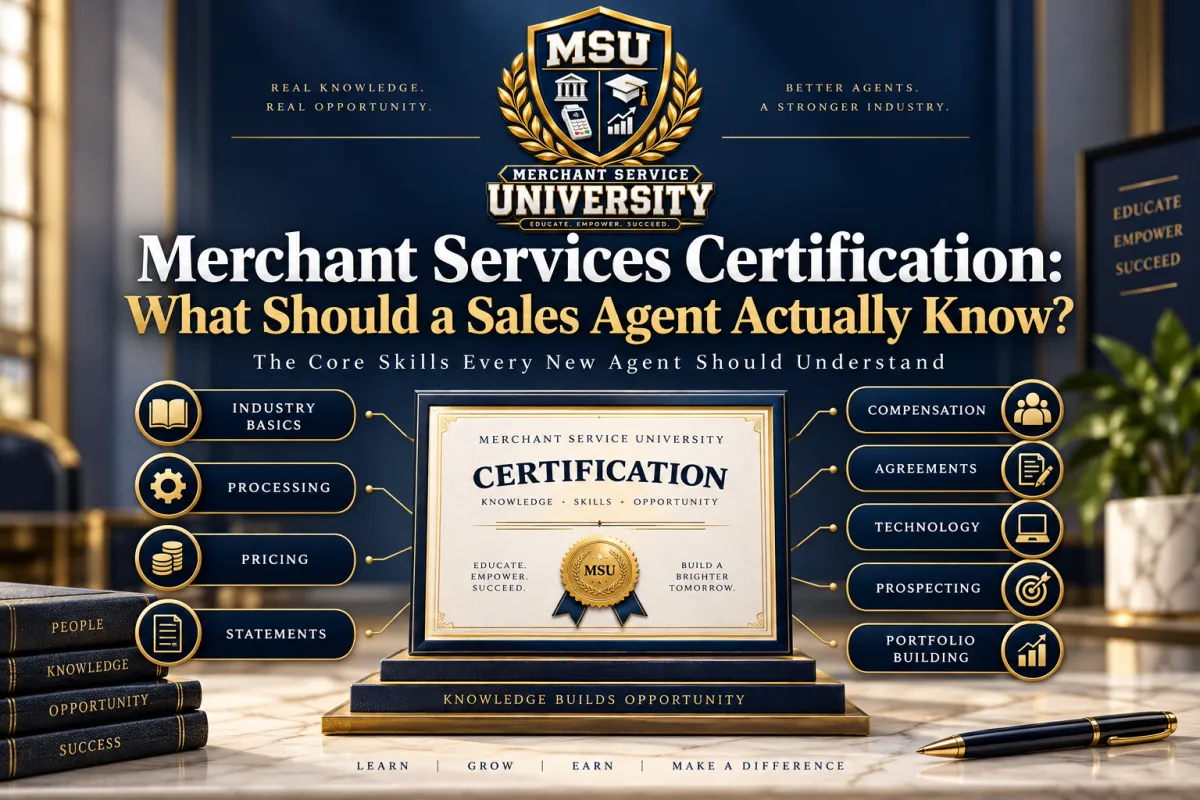
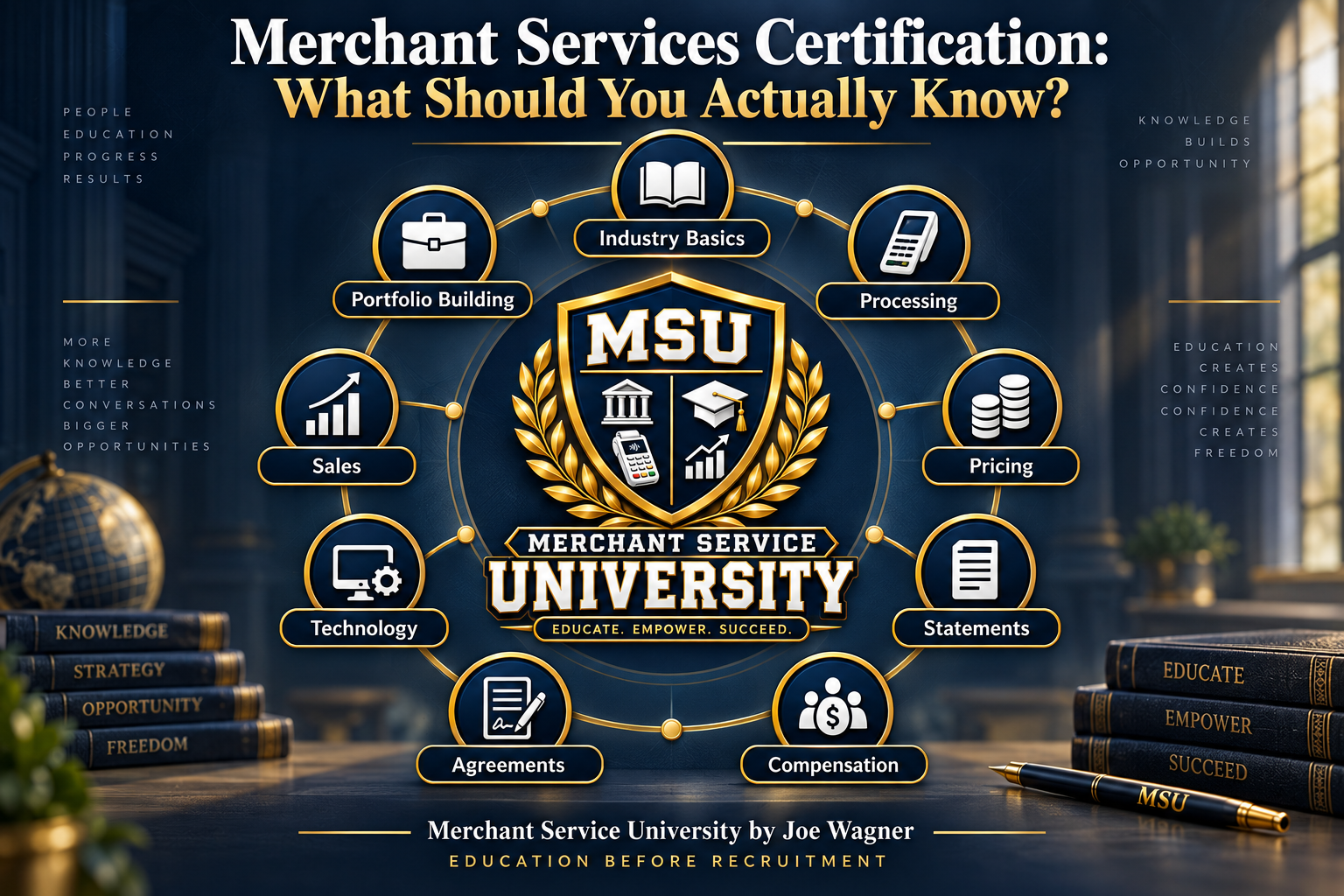
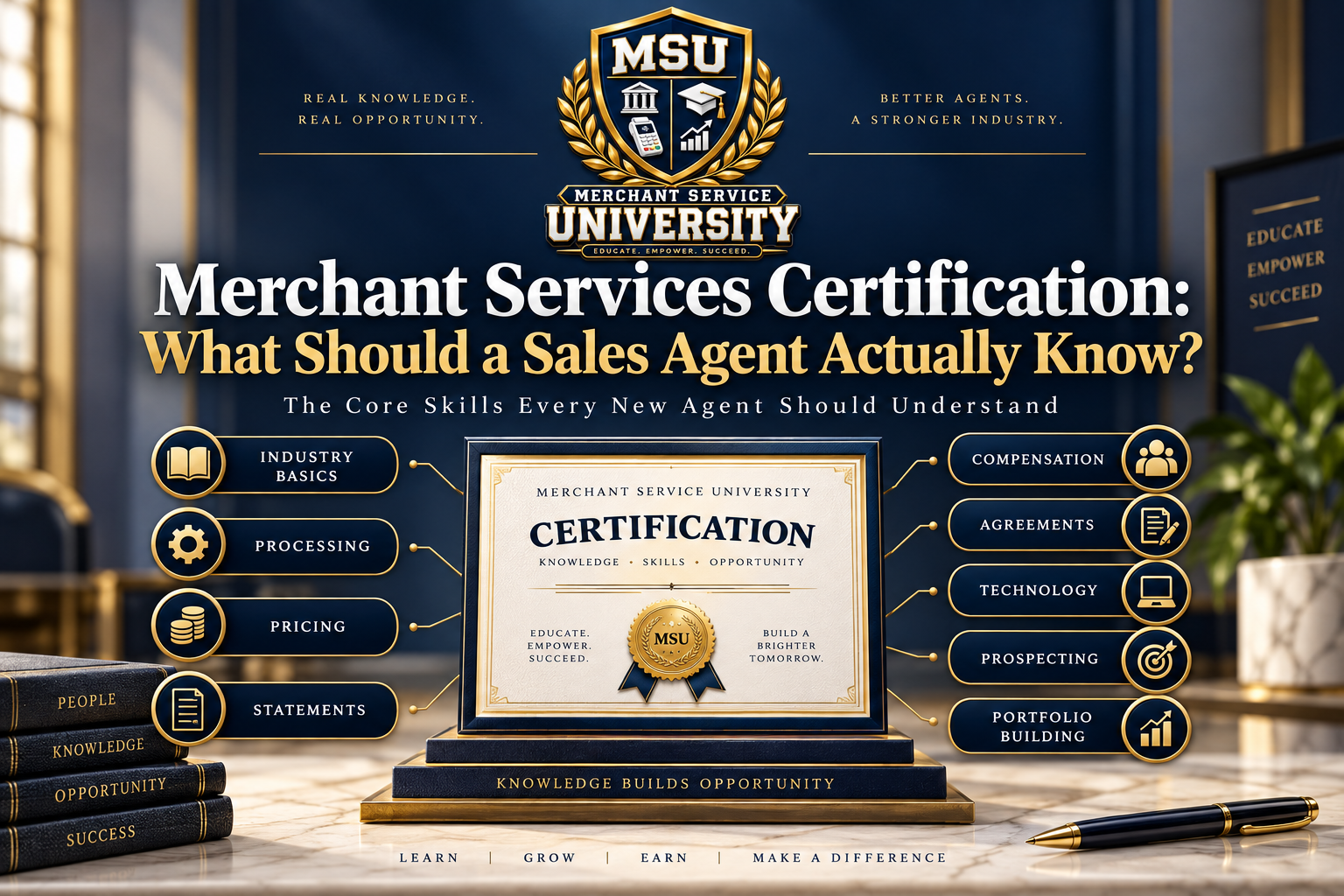
You progress through processing, pricing, statements, compensation, agreements, technology and sales.
Then you demonstrate that you've completed the foundation.
After that, the real learning accelerates through actual merchant conversations.
A Certified Agent Should Understand the Industry Structure
The first competency is simple:
Know who the major players are.
A merchant-services salesperson should understand the difference between the merchant, cardholder, issuing bank, acquiring relationship, processor, payment network, ISO and sales agent.
You don't have to explain the entire global payment ecosystem during every sales presentation.
But you should know where you fit inside it.
That context makes everything else easier to understand.
Why do processing fees exist?
Why is underwriting necessary?
Why can different organizations have different costs?
Why does an ISO exist?
Why doesn't the salesperson personally handle settlement?
If you're completely new to these concepts, start with my Merchant Services Sales Beginner's Guide.
A Certified Agent Should Understand How a Payment Transaction Works
You should understand the basic journey from payment to merchant funding.
A customer presents a card or another payment method.
The transaction is submitted through the merchant's payment technology.
An authorization decision occurs.
Approved transactions are later captured, cleared and settled according to the processing relationship.
There are financial institutions, payment networks and processing infrastructure involved throughout that journey.
Again, a salesperson does not need to become a payments engineer.
But you should be capable of explaining the basic process without making things up.
My guide on How Credit Card Processing Works for Sales Agents goes deeper into this part of the education.
A Certified Agent Should Understand Merchant Pricing
This is where a merchant-services salesperson begins becoming useful.
You should understand that a merchant's processing expense is not simply one mysterious percentage.
There can be underlying card costs, network expenses, processor or provider markup, transaction fees, monthly charges and other components depending on the pricing model.
You should understand the basic differences between common pricing approaches and be capable of discussing merchant costs without pretending every business is identical.
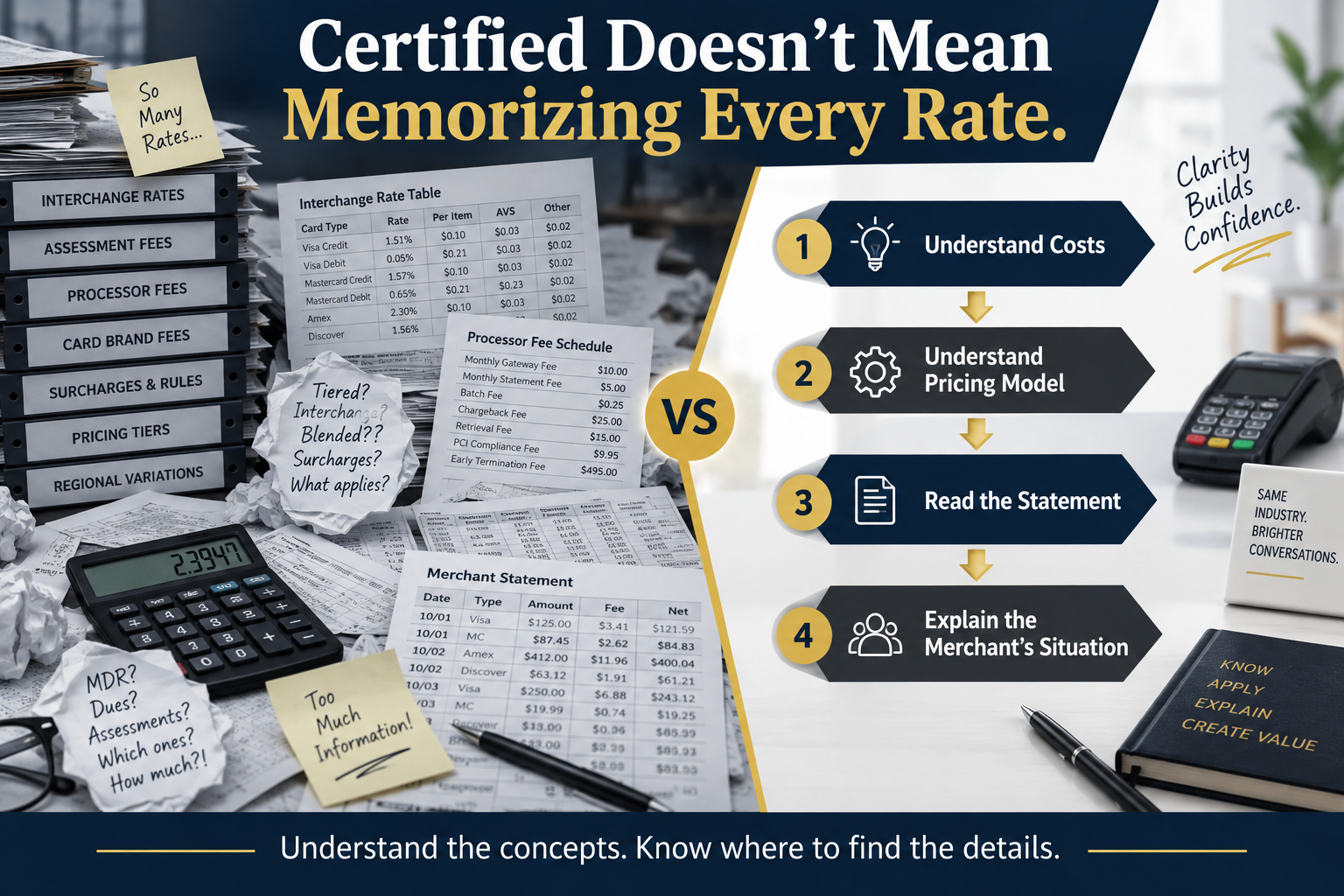
You do not need to memorize every interchange category.
That is not how I define competence.
I want you to understand enough to know where merchant pricing comes from and which parts of the relationship you may actually be able to influence.
A Certified Agent Should Be Able to Read the Basics of a Merchant Statement
I don't believe someone should complete foundational merchant-services training without knowing what information they are looking for on a processing statement.
You should be able to identify the merchant's approximate processing volume.
Transaction count.
Average ticket.
Monthly costs.
Transaction fees.
Pricing structure.
Additional fees.
You should be able to look at the statement and begin asking intelligent questions.
That does not mean every graduate will instantly be capable of analyzing every complicated processing statement in the industry.
Experience matters.
But you shouldn't be completely lost when a merchant hands you the document that describes the service you're trying to replace.
A Certified Agent Should Understand How THEY Get Paid
Merchant education is only half the equation.
Agents also need to understand their own economics.
How does an upfront commission work?
What is recurring residual income?
What does a 50% split actually mean?
What is a Schedule A?
What does vesting mean?
Can an upfront bonus be clawed back?
What happens if a merchant leaves?
What happens if you stop selling?
These are core business concepts.
You should know them before spending several years building accounts.
That's why we've dedicated several articles in this series to compensation, including How Merchant Services Agents Get Paid, Merchant Services Schedule A Explained, and Merchant Services Residual Splits Explained.
A salesperson who understands the merchant's economics but doesn't understand their own is only half educated.
A Certified Agent Should Understand Why 60% Is Not Automatically Better Than 50%
This is one of my favorite examples because it shows the difference between memorizing a number and understanding the business.
Company A offers you 50%.
Company B offers you 60%.
The beginner automatically picks Company B.
The educated agent asks:
What costs exist underneath each split?
If Company B has higher transaction costs, higher monthly expenses or other Schedule A costs, the 60% split can still produce less actual income.
We used a simple example earlier in this series.
A two-cent transaction-cost difference on 5,000 monthly transactions represents:
$100 per month in underlying cost difference.
That can matter more than the headline percentage.
Certification should teach you to ask better questions.
It isn't about giving you one "correct" company.
It's about helping you understand what you're comparing.
A Certified Agent Should Know What a Schedule A Is
I don't expect a beginner to become obsessed with every cost line.
But they need to understand what the Schedule A represents.
Your residual percentage tells you how the eligible economics are divided.
Your Schedule A helps define some of the underlying economics.
Those concepts work together.
If you're offered a 50% split, you should be able to look at major costs such as transaction expenses, monthly costs, statement fees or BIN/sponsorship-related fees and understand that those numbers can affect what is left to divide.
You can learn the detailed examples in Merchant Services Schedule A Explained.
A Certified Agent Should Understand Residual Vesting and Agreements
This may be even more important than understanding the split.
Suppose you spend ten years building a portfolio.
What happens to your residuals if you stop selling?
What happens if you leave the organization?
When do your residuals vest?
What can cause them to stop?
Are there production requirements?
Can costs change?
Are there clawback provisions?
What restrictions apply after termination?
A certificate should not turn you into a lawyer.
It should make you informed enough to know that these questions exist.
That is why I believe Merchant Services Agent Agreements, Lifetime Residuals, and Merchant Services Contract Red Flags belong in the educational conversation.
If you're about to build an asset, understand the agreement governing it.

A Certified Agent Should Understand the Difference Between a Sales Agent and a Registered ISO
This is another concept that gets confused online.
You do not need to create a registered ISO simply to begin building a merchant-services sales business through an established partner.
An individual salesperson can work through an upstream organization that already provides much of the processing, underwriting, compliance, product and support infrastructure.
A registered ISO operates at a different level of responsibility.
Card networks also maintain their own rules and registration programs for certain organizations operating as third-party agents. Visa, for example, requires registration of various Third Party Agents performing covered payment-related activities.
That is separate from MSU educational certification.
Completing MSU does not make you a Visa-registered ISO.
It teaches you enough to understand the distinction.
I explain why I believe most salespeople should focus on selling rather than immediately trying to become a registered ISO in Merchant Services Agent vs. ISO.
A Certified Agent Should Understand Basic Payment Security Responsibilities
Payment security is another area where salespeople need awareness without pretending to be compliance experts.
A merchant-services agent should at least understand what PCI DSS is and why merchants and payment providers care about protecting account data.
You should know enough to avoid casually telling merchants that security requirements "don't apply" simply because they use a third-party processor.
The PCI Security Standards Council maintains PCI DSS as a baseline set of technical and operational requirements designed to protect payment-account data.
Again, certification doesn't make an MSU graduate a PCI assessor.
It gives them foundational awareness.
Know the issue.
Know your limitations.
Know when the merchant needs guidance from the appropriate compliance or technical resource.
A Certified Agent Should Understand Modern Commerce Technology
The industry has moved far beyond standalone credit-card terminals.
Businesses may need payments integrated with:
Point of sale.
Appointments.
Invoicing.
E-commerce.
Online ordering.
Inventory.
Customer management.
Loyalty.
Employee tools.
Reporting.
But certification should also teach the opposite lesson:
Not every business needs all of that.
Sometimes a merchant truly needs a simple terminal.
The objective is not to memorize one company's software catalog and try to sell every feature.
The objective is to understand the categories of technology well enough to diagnose what would actually help the business.
That mindset is one of the biggest differences between product pitching and professional selling.
A Certified Agent Should Know How to Run Discovery
Industry knowledge matters only if you can apply it.
Good discovery means asking questions before presenting.
What is the merchant using today?
What is working well?
What isn't?
How are they accepting payments?
Do they sell online?
Do they take appointments?
Do they invoice?
Are they experiencing support problems?
Are they trying to reduce costs?
Are they doing something manually that could be automated?
Or are they completely happy and don't need to change anything?
You don't need to create a problem where one doesn't exist.
A properly educated salesperson should be capable of diagnosing before prescribing.
A Certified Agent Still Needs to Learn How to Prospect
Certification does not hand you merchants.
This is probably the most important reality check in the entire article.
You still need to pick up the phone.
You still need to walk into businesses.
You still need to follow up.
You still need appointments.
You still need to hear no.
You still have to develop sales skills.
MSU can teach you what you're selling and give you frameworks for how to sell it.
It cannot replace your activity.
I explain the larger skill set in Merchant Services Training: What Every New Agent Should Learn.
Certification should make you more prepared to prospect.
It should never become an excuse to avoid prospecting.
A Certified Agent Should Understand What Happens After the Sale
A sale isn't finished when the application is signed.
The merchant still has to move through underwriting.
Documents may be required.
The account has to be approved.
Technology needs to be configured.
The merchant has to activate.
Funding needs to work.
Employees may need help.
Support issues will eventually happen.
All of that affects merchant retention.
If you're building a residual portfolio, retention is part of compensation.
A merchant who leaves produces no future residual.
Certification should therefore teach agents to think beyond closing.
You're not simply acquiring applications.
You're building merchant relationships.
A Certified Agent Should Think in Portfolios
This is ultimately the mindset I want MSU graduates to develop.
Merchant services becomes extremely powerful when you stop thinking only about the commission from today's sale and begin thinking about the portfolio you're building behind you.
Merchant one.
Merchant ten.
Merchant twenty-five.
Merchant fifty.
Each merchant can potentially contribute recurring residual income while active, subject to your agreement and the economics of the account.
That is why the contract matters.
That's why support matters.
That's why retention matters.
That's why partner selection matters.
The goal is not just to learn enough to sell a terminal.
The goal is to understand how merchant acquisition can become a long-term business.
What Should MSU Certification Actually Prove?
By the time you complete the required Merchant Service University core curriculum, I want you to be able to explain—in your own words—the following:
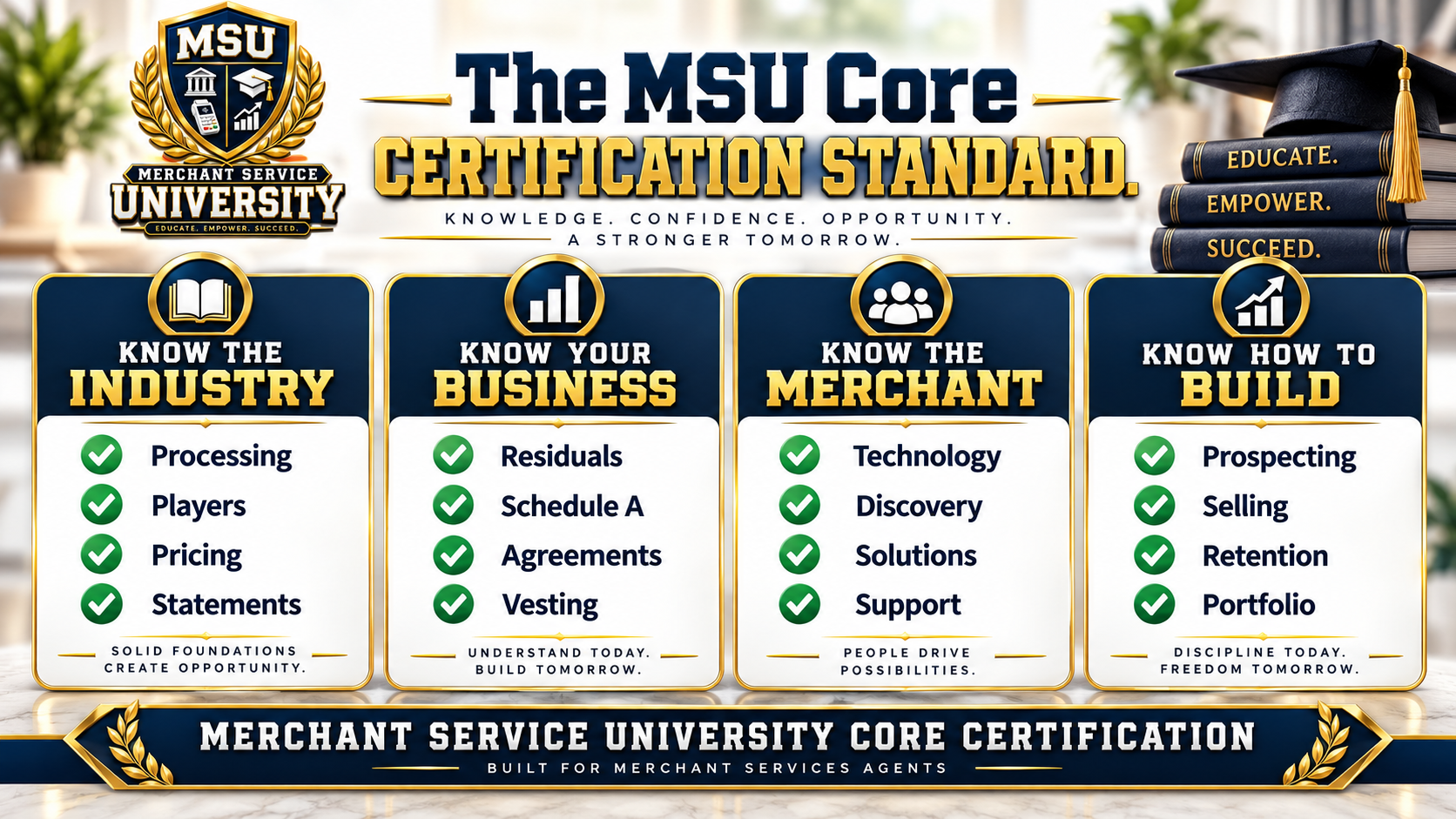
How the merchant-services ecosystem works.
How a basic payment transaction moves.
Where merchant processing costs come from.
How to identify the major information on a merchant statement.
How merchant-services agents can be compensated.
What a residual split means.
Why a Schedule A affects the residual.
What vesting and lifetime residual rights generally refer to.
Why an agent agreement deserves serious attention.
How modern payment and commerce technology can solve different merchant problems.
How basic discovery, prospecting and sales activity work.
Why onboarding, support and retention affect a residual portfolio.
Why different agents may need different processing partners.
Why education is the beginning—not a substitute for real-world experience.
That's the standard I'm trying to establish.
Not perfection.
Competence.
What MSU Certification Does NOT Mean
I want this stated just as clearly as what certification does mean.
MSU certification does not mean:
You are guaranteed a merchant-services job.
You are guaranteed to make money.
You are a registered ISO.
You hold a banking license.
You are licensed by Visa or Mastercard.
You are a PCI Qualified Security Assessor.
You know everything about payment processing.
You will never need additional training.
It means you completed an educational process designed to give you a working foundation.
That's it.
And I think that's valuable enough without pretending it is something else.
What Happens After MSU Certification?
After certification, we move from:
What do you need to learn?
to:
What do you want to build?
This is where partner matching can become useful.
I work with multiple merchant-services companies because different agents have different goals.
Maybe you're highly focused on recurring residual income.
Maybe you want stronger upfront cash flow while the portfolio develops.
One of the partners I work with can pay up to $10,000 upfront on certain qualified merchant deals based on profitability and program requirements.
That may be extremely attractive to one salesperson.
Another may care more about technology.
Or underwriting.
Or merchant support.
Or long-term portfolio economics.
That's why certification does not automatically funnel every student into one company.
After you've learned enough to understand the choices, we can talk about the choices.
My guide on How to Compare Merchant Services Companies explains how I think about that decision.
Why Education Comes Before Partner Matching
This is really the entire MSU model.
Imagine I tell you:
"Company A offers a 50% split with these Schedule A costs and strong vesting."
If you haven't completed the education, half that sentence may mean nothing.
Now imagine we've taught you residual splits.
Schedule A economics.
Vesting.
Contracts.
Merchant retention.
Technology.
Suddenly you can participate in the conversation.
You're not simply asking me to decide your future for you.
You understand enough to evaluate the recommendation.
That's the point.
I don't want MSU to create more dependent salespeople.
I want it to create more informed ones.
Is Merchant Services Certification Required to Sell?
Merchant Service University certification itself is not a legal requirement to sell merchant services.
It is an educational standard I created for the MSU program.
Merchant-services relationships, companies and payment-network roles can have their own onboarding, registration, compliance or contractual requirements depending on what the person or organization is actually doing.
That is a separate issue from educational certification.
I created MSU certification because I believe the fact that someone can start selling without much education doesn't mean they should remain uneducated.
Those are two different standards.
Is Merchant Services Certification Worth It?
If the certification is attached to useful education, I think the education is the value.
The certificate itself isn't going to build your portfolio.
Understanding processing might help you explain a merchant's situation better.
Understanding statements might help you identify an opportunity.
Understanding residuals might prevent you from choosing a bad compensation arrangement.
Understanding agreements might help you ask an important question before signing.
Understanding technology might help you recommend a better merchant solution.
Understanding prospecting might help you create more conversations.
That's where the value is.
A certificate without knowledge is decoration.
Knowledge that changes your decisions is useful.
How Much Does MSU Certification Cost?
The core Merchant Service University training and certification process is designed around our free core education.
I built it that way intentionally.
As I explained in What Is Merchant Service University?, I created MSU after becoming frustrated with watching people pay thousands of dollars to online course sellers simply to access the merchant-services opportunity, then hearing from some people who felt they were still not properly prepared afterward.
I make my living in merchant services.
I don't need to make my living selling you a high-ticket course about merchant services.
That allowed me to invest my own resources into creating the education and make the core program accessible without a massive tuition bill.
How to Earn Merchant Service University Certification
Start at:
Work through the required core education.
Don't race through it just to collect the certification.
Understand the concepts.
Take notes.
Revisit areas that don't make sense yet.
Complete the requirements.
Then use the certification as your transition from learning the foundation into actually applying it.
The MSU Path
Learn Free
↓
Complete the Core Training
↓
Earn MSU Certification
↓
Define What You Want to Build
↓
Talk With Joe if You Want Help
↓
Explore Potential Partners
↓
Start Building Your Merchant Portfolio
That's the process.
Frequently Asked Questions About Merchant Services Certification
What is merchant services certification?
Merchant services certification generally refers to educational training confirming that someone has completed a defined curriculum about the payments industry. Merchant Service University certification confirms completion of the required MSU foundational education.
Is there a government-issued merchant services sales certification?
MSU certification is not a government-issued credential. Different companies, organizations and payment-network roles may have their own registration, compliance or onboarding requirements, which should not be confused with educational certification.
Is Merchant Service University certification a license?
No. MSU certification is an educational credential. It is not a banking license, government license, card-network registration or state-issued professional designation.
Does MSU certification make me a registered ISO?
No. A registered ISO is a separate business and payment-network relationship. Completing Merchant Service University does not make someone a registered ISO.
What should a certified merchant-services agent know?
A properly trained agent should understand industry structure, transaction flow, merchant pricing, statements, agent compensation, residuals, Schedule A economics, agreements, commerce technology, discovery, prospecting, onboarding, retention and portfolio building.
Do merchant-services agents need to understand PCI DSS?
Agents should understand the basic purpose of PCI DSS and payment-data security, while recognizing when merchants need guidance from appropriate compliance or technical professionals. MSU certification does not make someone a PCI assessor.
Does merchant-services certification guarantee income?
No. Certification demonstrates completion of education. Income depends on factors such as sales activity, ability, merchant acquisition, merchant retention, compensation structure and market conditions.
Is MSU certification free?
The MSU certification process is built around the free Merchant Service University core education. Visit MerchantServiceUniversity.com for the current program details and requirements.
What happens after MSU certification?
Students decide what they want to build. Those who want help entering or expanding within merchant services can also talk with Joe Wagner about their goals and potentially explore partner options.
Does certification automatically place me with a merchant-services company?
No. MSU education and certification do not require a student to join one specific partner. Partner evaluation happens after the educational foundation.
Can experienced merchant-services agents become MSU certified?
Yes. Experienced agents can use the core curriculum to validate and strengthen their foundational knowledge, particularly in areas they may not have been formally taught.
Where do I start merchant-services certification?
Begin the Merchant Service University core education at MerchantServiceUniversity.com.
Final Takeaway: Certification Should Mean You Know the Foundation
I don't care about giving people a certificate just so they can post it online.
I care about what they learned before receiving it.
Can you explain how the industry works?
Do you understand a payment transaction?
Can you read the basic information on a merchant statement?
Do you understand pricing?
Do you know how your own residual is calculated?
Do you understand what a Schedule A is?
Do you know why vesting matters?
Have you thought about the agent agreement?
Can you identify different types of merchant technology?
Can you run a basic discovery conversation?
Do you understand that prospecting still has to happen?
Do you understand why merchant retention protects a residual portfolio?
If the answer to those questions is yes, now we have something useful.
You have a foundation.
You don't know everything.
Neither do I after more than 16 years in this industry.
But you know enough to start asking intelligent questions, making better decisions and gaining real-world experience.
That is what Merchant Service University certification is supposed to represent.
Not permission to dream.
Preparation to do the work.
Start the core education free at MerchantServiceUniversity.com.
Learn first.
Get certified.
Then decide what you want to build.
And if you want help evaluating the next step after certification, reach out through JoeWagner.com.
Get educated before you get recruited.
About Joe Wagner
Joe Wagner has spent more than 16 years in merchant services and payment-processing sales, acquiring merchants, building recurring-revenue portfolios and developing sales organizations.
He created Merchant Service University to give new and experienced salespeople a structured educational foundation before requiring them to choose a processing partner.
The MSU core education is designed to teach the business behind merchant services—processing, pricing, statements, compensation, agreements, technology, sales and portfolio building—before students evaluate potential opportunities.
Joe also works with qualified sales representatives who want help exploring merchant-services partner relationships based on priorities such as residual economics, upfront compensation, technology, underwriting and merchant support.
Continue your education with Merchant Services Training: What Every New Agent Should Learn, Merchant Services Training for Beginners, What Is Merchant Service University?, and How to Compare Merchant Services Companies.
Or begin your core MSU education at MerchantServiceUniversity.com.