What Is Merchant Service University? Free Training & Certification
What Is Merchant Service University? How MSU Training and Certification Work
Merchant Service University, or MSU, is a free merchant-services education platform I created to teach people how the payments industry actually works before anyone tries to recruit them into a processing company.
But MSU didn't start because I woke up one day and thought the internet needed another course.
It started because I got tired of watching people sell access to this industry.
Over time, I started seeing more people online charging thousands of dollars to teach others how to "start a payment-processing business," create residual income or break into merchant services.
Then I started hearing directly from people who had paid for some of these programs.
The story I heard too often was similar.
They spent thousands of dollars expecting a serious education and a clear understanding of the business. Then afterward, some told me they felt like they had not received nearly the depth, practical training or ongoing understanding they expected when they made the purchase.
That bothered me.
What bothered me even more was watching the dream of merchant services become the product.
Passive income.
Financial freedom.
Lifetime residuals.
Starting your own payments company.
Those are powerful ideas, and there are legitimate opportunities behind them. I know because I've spent more than 16 years actually working in this industry.
But there is a major difference between making your living in merchant services and making your living selling people the dream of merchant services.
I make my money doing the business we're actually talking about doing.
I've sold merchant services.
I've acquired merchants.
I've built recurring residual portfolios.
I've developed sales organizations.
I've worked through the problems that come with underwriting, merchant support, pricing, technology, agreements and retention.
I don't need to sell you a $10,000 course in order to monetize what I know.
So I went in the opposite direction.
I invested my own money and time into building a full-scale educational process and made the core Merchant Service University training free.
I wanted people to have another option before paying thousands of dollars to someone online simply because that person knew how to sell the opportunity.
The philosophy became simple:
Get educated before you get recruited.
Learn how the industry works.
Understand the compensation.
Understand the agreement.
Understand what you're actually building.
Then decide whether merchant services is right for you and which type of partner makes sense.
Why I Created Merchant Service University
Merchant Service University was really born out of frustration.
Merchant services is a legitimate industry where salespeople can acquire real customers, create real value for businesses and potentially build substantial recurring residual portfolios over time.
That also makes it incredibly easy to package the opportunity into a high-ticket online course.
Sell the dream.
Charge thousands of dollars.
Then introduce the industry.
I wanted to reverse that order.
Instead of:
Pay Thousands → Hear the Opportunity → Join a Company → Try to Learn the Business
I wanted:
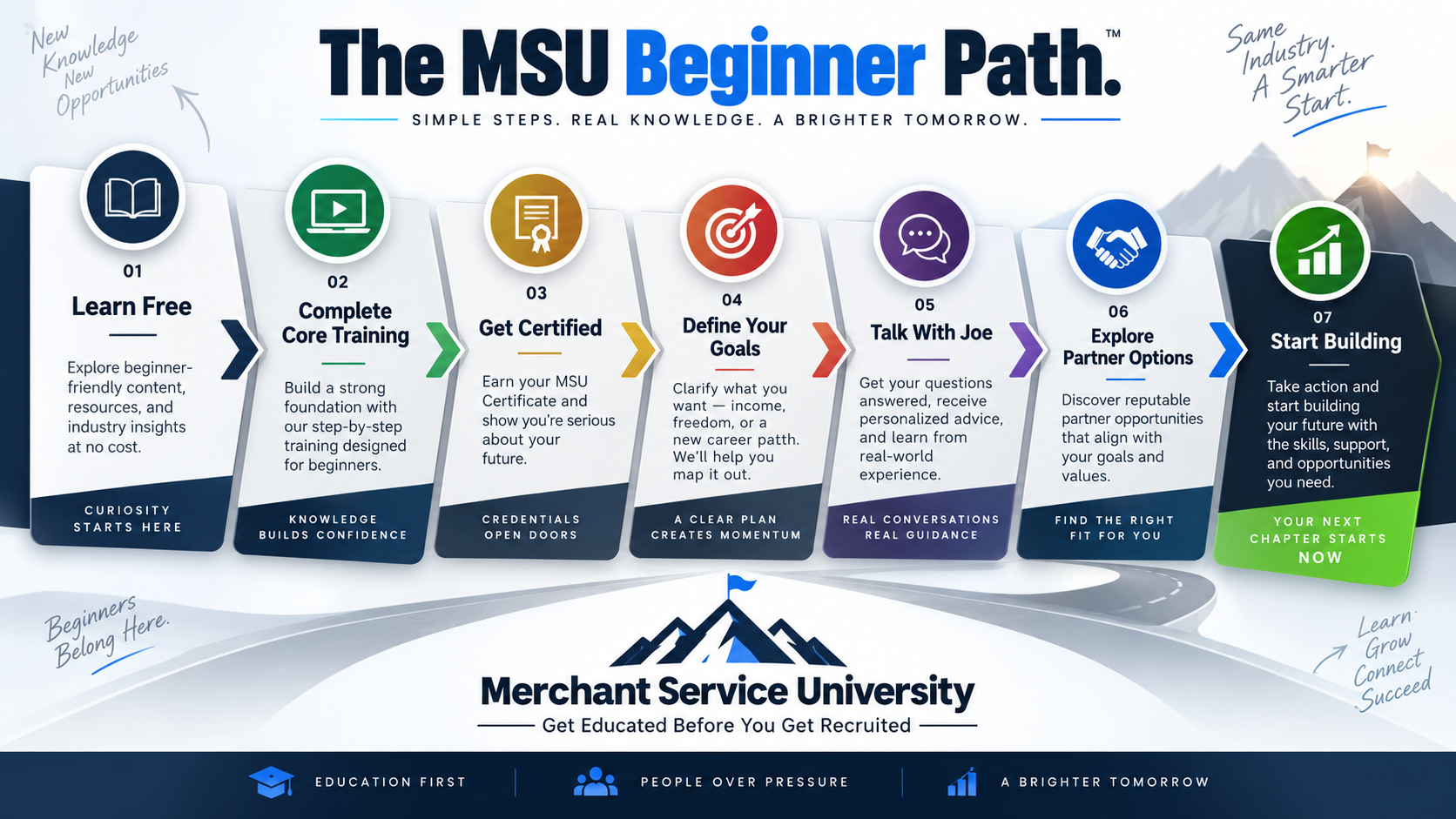
Learn the Business → Understand the Opportunity → Get Certified → Decide Whether It Fits You → Explore Partner Options
That is the foundation of MSU.
I'm not saying every paid merchant-services program is bad.
I'm not saying everyone charging for coaching lacks experience.
There are excellent coaches, consultants and educators in many industries, and specialized paid education can absolutely be worth the investment.
I've invested heavily in my own education throughout my career.
My issue is with the idea that someone should have to spend thousands of dollars simply to gain enough knowledge and access to determine whether merchant services is even right for them.
I especially don't like seeing beginners sold primarily on income potential before they understand the work, economics and contracts underneath it.
So I built what I thought was missing.
A real educational foundation.
And I made the core training free.
I Don't Need to Sell You the Course
This is one of the biggest differences I want people to understand about MSU.
My livelihood doesn't depend on selling Merchant Service University.
I make my money in merchant services.
That gives me the freedom to teach the core education without needing every student to become a high-ticket course sale.
I invested my own resources into the program because I believe better-educated people entering the payments industry create better outcomes.
They make better decisions about companies.
They understand their compensation.
They read their agreements.
They ask better questions.
They make better recommendations to merchants.
They are less likely to get excited by one big recruiting number without understanding what is underneath it.
And when I eventually have a conversation with an MSU student about potential partner options, that conversation is much more productive because we are speaking the same language.
I Want Merchant Service University to Make You Harder to Sell
That may sound strange coming from someone who also helps agents find merchant-services opportunities.
But that's exactly what I want.
If someone tells you:
"We pay 60% residuals."
I want you asking:
"Sixty percent of what?"
If someone promises:
"Lifetime residuals."
I want you asking:
"When do they vest, and what does the agreement say happens if I leave?"
If a company says:
"We have the best technology."
I want you asking:
"Best for which types of businesses?"
If someone tells you:
"This is the best merchant-services agent program."
I want you asking:
"Based on what?"
And if someone tells you that you need to pay them $10,000, $15,000 or $25,000 before they'll teach you how this industry works, I want you to at least know enough to evaluate exactly what you're buying.
Education should make you less dependent on a sales pitch.
Not more dependent on one.
Is Merchant Service University Free?
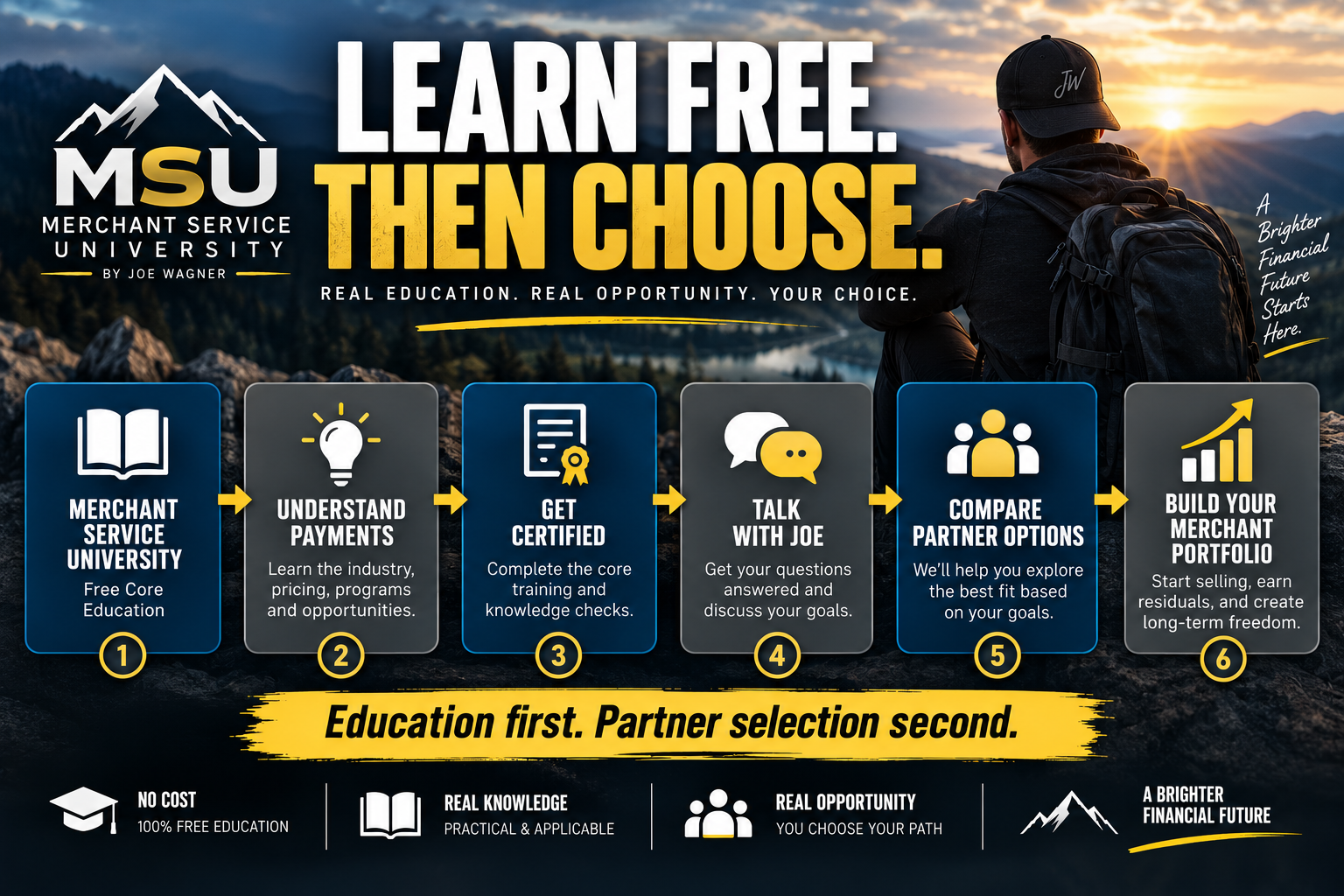
Yes. Merchant Service University education is free.
You don't have to pay thousands of dollars to access the foundational curriculum.
You also aren't required to join one specific processing company after completing it.
That is intentional.
I want you to be able to learn enough about merchant services to make an informed decision before a major financial commitment or long-term agent agreement enters the conversation.
If you later decide you want advanced coaching, specialized consulting, conferences, sales development or another paid educational resource, evaluate those options based on their value.
But you can learn the foundation first.
I explain this philosophy further in Can You Start Selling Merchant Services for Free?.
Who Is Merchant Service University For?
MSU was designed for both new and experienced salespeople.
If you've never worked in payments, the program gives you a structured place to begin.
If you're an experienced salesperson coming from insurance, telecommunications, real estate, home services, B2B sales or another commission-driven field, MSU can teach you how your existing sales skills fit into the payment-processing business.
If you're already selling merchant services, you may discover that there are areas you were never properly taught.
Maybe you've sold for years but never really understood your Schedule A.
Maybe you understand processing but haven't paid enough attention to vesting or your agent agreement.
Maybe you're strong at traditional processing but need a better understanding of modern commerce systems.
Maybe you're simply trying to determine whether your current merchant-services company is still the right fit.
MSU gives you a structured foundation without requiring you to pretend you know nothing.
What Does Merchant Service University Teach?
The core curriculum is designed to teach the business in a logical progression.
You begin with industry basics.
Who are the players?
What does a processor do?
What is an ISO?
Where do issuing banks, acquiring relationships, card networks and software companies fit?
What role does the merchant-services sales agent play?
From there, you move into how transactions work, pricing, merchant statements, agent compensation, agreements, modern commerce technology, prospecting, sales, retention and portfolio building.
The goal is not simply helping someone close one merchant.
The goal is helping someone understand the business they are trying to build.

MSU Starts With How the Payments Industry Actually Works
Before learning a pitch, I want you to understand what you're selling.
A customer presents a payment.
That transaction moves through technology, networks, financial institutions and processing infrastructure.
There are multiple players involved.
There are costs associated with that infrastructure.
There are security responsibilities.
There are different ways payments can be accepted.
Once you understand the ecosystem, many of the other topics become much easier.
You don't need to become a payment engineer.
You need enough understanding that you're not selling something you cannot explain.
If you're starting from zero, my Merchant Services Sales Beginner's Guide and How Credit Card Processing Works for Sales Agents are strong companion resources.
MSU Teaches How Merchant Services Agents Get Paid
This is one of the most important areas for any new agent.
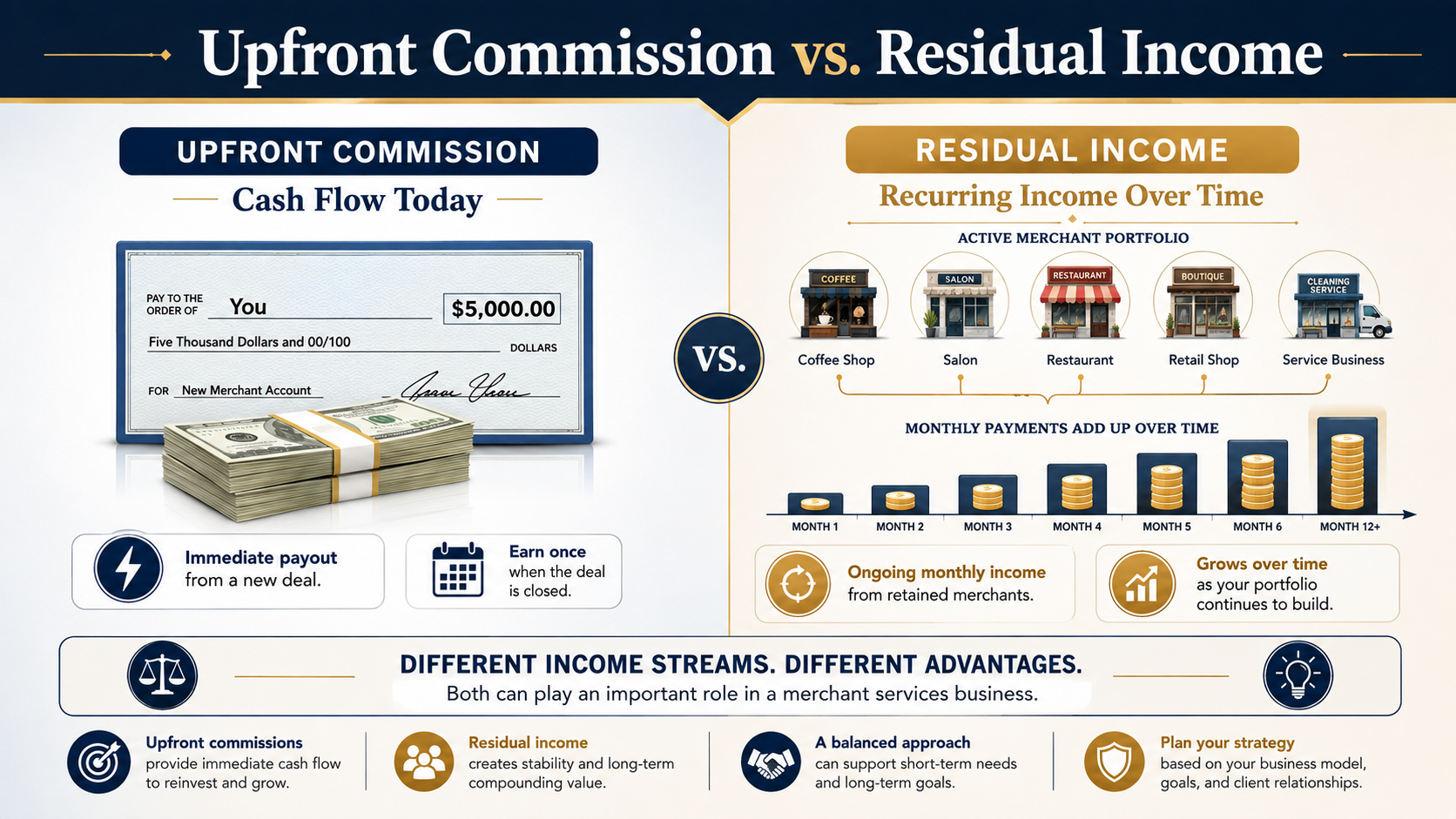
Merchant-services compensation can involve upfront commissions, residual income or a combination of both.
But the numbers need context.
If someone offers you a 50% residual split, what is the 50% being calculated from?
What costs come out first?
What does a Schedule A do?
When do your residuals vest?
Can the residual continue after you stop selling?
Are there upfront bonuses?
Can those bonuses be clawed back?
These are fundamental business questions.
You shouldn't discover the answers three years after joining a company.
We've created detailed resources throughout this series covering Merchant Services Agent Commissions, Merchant Services Schedule A, Merchant Services Residual Splits, Lifetime Residuals and Upfront Commissions vs. Residual Income.
MSU brings these concepts together as part of the larger education.
MSU Teaches Why a Bigger Residual Percentage Isn't Automatically Better
This is a perfect example of why education matters before recruitment.
One company offers you 50%.
Another says 60%.
The beginner thinks:
60% must be better.
Maybe it is.
Maybe it isn't.
If the company offering 60% has higher underlying transaction costs, monthly fees or other Schedule A expenses, there may be less profit left to divide.
That can result in a higher advertised percentage producing a lower actual residual payout.
This is why I generally like a clean 50% relationship when the underlying economics, residual rights and support are strong.
If production later justifies 55% or 60%, that's great.
The point is that MSU teaches you to evaluate the entire compensation structure rather than chasing the largest number printed on a recruiting page.
MSU Teaches Merchant Pricing and Statement Analysis
If you're going to sell payment processing, you should eventually be able to look at a merchant statement and understand the major pieces of what you're seeing.
How much does the merchant process?
How many transactions are occurring?
What pricing structure are they on?
What fees are being charged?
What is potentially controllable?
What costs may be part of the payment ecosystem?
The goal is not to turn students into accountants.
The goal is to stop salespeople from walking into businesses saying:
"I can save you money."
without understanding what the merchant currently pays.
Good sales begins with understanding.
MSU Teaches Agent Agreements Before You Build the Portfolio
This is one of the areas I wish more people learned early.
Most agents are excited about their residual percentage.
Few are initially excited about reading the contract.
But if you build a serious portfolio, the agreement can eventually become more important than the recruiting pitch that got you started.
When do your residuals vest?
What happens if you leave?
What happens if you stop producing?
Can underlying costs change?
Are there production minimums?
What can trigger a clawback?
What restrictions apply after termination?
What happens to the residual stream you've spent years building?
These are questions I want agents asking before they become emotionally invested in a company.
Use 11 Questions to Ask Before Signing a Merchant Services Agent Agreement and Merchant Services Contract Red Flags alongside the training.
MSU is education, not legal advice, but education helps you know when you need to ask better questions or seek professional advice.

MSU Teaches Modern Commerce, Not Just Credit Card Rates
Merchant services is no longer only about replacing countertop terminals.
Modern businesses can use payment technology alongside point of sale, e-commerce, online ordering, appointments, invoicing, inventory, customer management, loyalty, employee management, reporting and other business tools.
That doesn't mean every business needs an advanced system.
Some merchants just need a simple terminal and fair processing.
The goal is not to upsell everyone into unnecessary technology.
The goal is to learn how different businesses operate so you can recommend the right solution.
That's a better sales approach and a better way to retain merchants.
MSU Teaches Prospecting Because Education Alone Doesn't Build a Portfolio
You can know everything about interchange and still make zero dollars if you never talk to merchants.
Merchant Service University also connects the industry education to sales activity.
How do you identify prospects?
How do you start conversations?
How do you prospect by phone or in person?
How do you run discovery?
How do you follow up?
How do you present value?
How do you close?
You don't need ten expensive tools before you begin.
You need merchant conversations.
I've seen people spend weeks designing a business instead of actually building one.
Education matters.
Execution matters more once the foundation is in place.
MSU Teaches Discovery Before the Pitch
I don't want a new agent memorizing one product presentation and forcing it onto every merchant.
Good merchant-services selling begins with questions.
What is the business using now?
What do they like?
What frustrates them?
How are they accepting payments?
What technology are they missing?
How much manual work exists?
Are they overpaying?
Do they need a better point-of-sale system?
Would a simple terminal be enough?
The merchant tells you where the opportunity is.
Your job is to listen well enough to find it.
That mindset is part of becoming a professional merchant-services salesperson rather than a walking rate quote.
MSU Teaches Portfolio Building Instead of Just Chasing the Next Commission
This is one of the biggest lessons in the entire business.
An upfront commission is useful.
A portfolio can change the way your business works.
Suppose you sign merchant number one.
Then merchant number two.
Then ten.
Then twenty-five.
Then fifty.
If those accounts remain active and your contractual residual rights remain intact, your earlier sales can continue contributing to recurring income while you're adding new merchants.
That compounding effect is why I believe merchant services is such a powerful opportunity for salespeople.
But the residual portfolio only becomes valuable when merchants stay.
That means onboarding matters.
Support matters.
Pricing matters.
Technology matters.
And the company you partner with matters.
What Does Merchant Service University Certification Mean?
After completing the required core education, students can earn Merchant Service University certification.
I want to be very clear about what that means.
MSU certification demonstrates that you've completed the foundational educational curriculum required by Merchant Service University.
It is not a government license.
It is not a banking license.
It is not a state-issued professional designation.
It does not mean that you suddenly know everything there is to know about payment processing.
Merchant services is far too large for that.
Certification means something much more practical:
You completed the foundation.
You understand the terminology.
You've been exposed to processing, pricing, statements, compensation, agreements, technology and sales.
You are now in a better position to make informed decisions and begin applying what you've learned.
Certification Is the Starting Line, Not the Finish Line
One of the worst things someone could do is complete MSU and think:
I'm certified. Now I'm done learning.
You're just getting started.
Real merchant conversations will teach you things a video never can.
You will encounter underwriting situations.
Merchant objections.
Pricing questions.
Technology issues.
Competitive situations.
Support problems.
Deals you win.
Deals you lose.
That's where knowledge turns into experience.
Certification gives you a foundation.
Selling builds the professional.
What Happens After You Complete MSU?
After completing the core program, the next step is deciding what you're trying to build.
This is where I can help.
I work with multiple merchant-services partner relationships because I don't believe every agent should automatically join the same company.
One agent may care most about long-term residual income.
Another may need substantial upfront compensation.
Another may need specific technology.
Another may need a particular underwriting profile.
Another may care most about merchant support.
For example, one of the partners I currently work with can pay up to $10,000 upfront on certain qualified merchant accounts based on profitability and program requirements.
That can be extremely attractive to an experienced salesperson pursuing profitable merchants.
But another salesperson may care very little about the giant upfront commission.
They may care more about another partner's technology, support structure or long-term residual strategy.
This is exactly why I don't teach MSU as:
Take the course → Join Company X.
The process is:
Learn → Get Certified → Define Your Goals → Talk With Joe → Explore Potential Partners → Decide What Fits

MSU Is Free, But I Still Have a Business
I want to be transparent about this because I think transparency is part of what I'm teaching.
Merchant Service University is not a charity disconnected from my business.
I work in merchant services.
I have relationships with companies where I can help connect qualified salespeople with potential opportunities.
If someone completes MSU, we determine that one of my partners is a good fit and we eventually do business together, there can be a financial benefit to me.
I'm completely comfortable telling you that.
The difference is that you don't have to pay me thousands of dollars upfront just to become educated enough to have that conversation.
The education comes first.
You learn what residuals are.
You understand your Schedule A.
You know what vesting means.
You understand the basics of an agent agreement.
Then, if we talk about a partner, you can evaluate the opportunity with knowledge instead of blind trust.
That's the model I wanted.
Does Completing MSU Mean You Have to Work With Me?
No.
The core education does not obligate you to work with me or one of my partners.
Maybe you complete MSU and decide you don't like merchant services.
That's fine.
Maybe you already work with a processing organization you love.
Stay there.
Maybe you find another opportunity independently.
That's your choice.
Maybe you want my help sorting through options.
We can do that too.
Education should increase your ability to make your own decisions.
Why I Work With Multiple Merchant Services Companies
If one company were automatically the best choice for every salesperson, I wouldn't need multiple relationships.
But that's not reality.
Different companies have different strengths.
Different agents have different needs.
The high-producing closer targeting large merchants is not necessarily looking for the same relationship as the new agent building local small businesses.
Someone focused heavily on recurring residual income may value different terms than someone prioritizing substantial upfront compensation.
Someone selling a specific merchant vertical may need particular technology or underwriting.
That's why I believe the agent should be matched to the partner—not forced into a predetermined company.
My guide on How to Compare Merchant Services Companies explains this philosophy in much more detail.
Is Merchant Service University Only for Beginners?
No.
Beginners obviously benefit because they need the foundation.
But experienced agents can benefit too.
I've met talented salespeople who didn't understand the economics underneath their residual split.
I've met agents who had been in the industry for years but had never closely studied their agreement.
Others understood processing but needed to catch up with modern commerce technology.
Some simply wanted a structured refresher and a better way to evaluate their current company.
Experience doesn't automatically mean you've been taught everything.
MSU can help fill those gaps.
Can You Become a Merchant Services Agent Without MSU?
Absolutely.
Merchant Service University is not a government requirement.
It is not a licensing body.
There are many ways to enter merchant services.
MSU exists because I believe people make better decisions after receiving structured education.
I am not trying to create another gatekeeper.
I'm trying to remove one.
You shouldn't need to spend thousands of dollars or blindly join a processing company just to begin understanding the business.
What Does Merchant Service University Cost?
The core Merchant Service University education costs you nothing.
That was a deliberate decision.
I invested my own time and money into building it.
I'm willing to do that because I make my living in the industry I'm teaching.
I don't need to maximize course sales.
I'd rather create a larger pool of properly educated merchant-services professionals.
Some may eventually work with me.
Some won't.
Either outcome is better than someone making a major decision about the industry without understanding what they're getting into.
How to Start Merchant Service University
Starting is simple.
Go to:
https://merchantserviceuniversity.com
Begin the core training.
Don't rush through it just to get to the certification.
Learn the terminology.
Understand the examples.
Go through the compensation material.
Learn what your future agreement may contain.
Understand how merchants actually use payment technology.
Then complete the certification requirements.
After that, decide what you want to build.
If you'd like my help exploring the next step, we can talk.
Start Merchant Service University Free
Free core education. No obligation.
Learn first. Get certified. Then decide what you want to build.
Frequently Asked Questions About Merchant Service University
What is Merchant Service University?
Merchant Service University is a free merchant-services education platform created by Joe Wagner to teach payment processing, pricing, statements, agent compensation, agreements, modern commerce technology, sales and portfolio building before students choose a processing partner.
Why did Joe Wagner create Merchant Service University?
Joe created MSU after becoming frustrated with seeing people pay thousands of dollars for online merchant-services programs and hearing from some buyers who felt they did not receive the depth of education they expected. He wanted to create a comprehensive education-first alternative that did not require a large upfront course purchase.
Is Merchant Service University free?
Yes. The core Merchant Service University education is free.
Why doesn't Merchant Service University charge thousands of dollars?
Joe makes his living working in merchant services rather than relying primarily on high-ticket course sales. He chose to invest his own time and resources into building the core program and make the education accessible without a large upfront tuition payment.
Do I have to join a merchant-services company to take MSU?
No. Completing the core training does not obligate you to join one specific merchant-services company.
Who created Merchant Service University?
Merchant Service University was created by Joe Wagner, who has spent more than 16 years working in merchant services, sales, merchant acquisition, residual portfolios and sales organizations.
What does Merchant Service University teach?
MSU covers industry basics, payment processing, pricing, statements, agent compensation, Schedule A economics, agreements, modern commerce technology, prospecting, sales, retention and portfolio building.
Is MSU only for beginners?
No. Beginners can use MSU to build their foundation, while experienced merchant-services agents can use the program to strengthen areas such as compensation, contracts, technology and portfolio strategy.
What is Merchant Service University certification?
MSU certification represents completion of the required foundational curriculum. It is an internal educational certification and is not a government license, banking license or state-issued professional credential.
Does MSU certification guarantee income?
No. Certification confirms completion of educational material. Results depend on individual effort, sales ability, merchant acquisition, retention, partner economics and other business factors.
What happens after I complete MSU?
After certification, students can determine what they want to build. Those interested in pursuing merchant services can also speak with Joe Wagner about their priorities and potential partner options.
Does Joe Wagner work with multiple merchant-services companies?
Yes. Joe works with multiple partner relationships because agents can have different priorities involving residual income, upfront compensation, technology, underwriting and merchant support.
Can an agent receive a large upfront commission through one of Joe's partners?
Potentially. One partner Joe works with can pay up to $10,000 upfront on certain qualified merchant accounts based on profitability and program requirements. Compensation is not guaranteed and varies by merchant and program.
Do I have to work with Joe after completing Merchant Service University?
No. The core education does not obligate students to work with Joe or any particular merchant-services company.
How do I start Merchant Service University?
Visit MerchantServiceUniversity.com and begin the free core training.
Final Takeaway: I Built the Program I Wish More People Had Before They Paid Thousands
Merchant Service University exists because I got tired of watching people pay thousands of dollars just to gain access to an industry they still didn't fully understand afterward.
I heard from people who felt disappointed by programs they had purchased.
I watched the dream of recurring residual income become a product of its own.
And I kept thinking:
There should be a better way to enter this industry.
So I built one.
I invested my own time and money into creating a real educational process.
Then I made the core training free.
I can do that because I don't need to make my living selling Merchant Service University.
I make my living doing the business Merchant Service University teaches.
I want you to learn processing.
Understand pricing.
Read statements.
Understand residuals.
Understand the Schedule A.
Know what vesting means.
Read your agreement.
Understand merchant technology.
Learn to prospect.
Learn to sell.
Learn how to retain merchants.
Understand what building a portfolio actually looks like.
Then make your decision.
Maybe you complete MSU and decide merchant services isn't for you.
That's okay.
Maybe you complete it and decide you want to build a serious portfolio.
Great.
Maybe you want help determining which of the partner companies I work with best fits your goals.
We can have that conversation too.
But the education comes first.
Because I would rather help create educated merchant-services professionals than sell another person access to a dream they don't yet understand.
Start free at MerchantServiceUniversity.com.
Learn first. Get certified. Then decide what you want to build.
Get educated before you get recruited.
About Joe Wagner
Joe Wagner has spent more than 16 years in merchant services and payment-processing sales, acquiring merchants, building recurring-revenue portfolios and developing sales organizations.
He created Merchant Service University after becoming frustrated with the education-first gap he saw in the industry and hearing from people who had spent significant money on online merchant-services programs without feeling properly prepared afterward.
Rather than building MSU around high-ticket course tuition, Joe invested in creating the core education and made it free. His business remains centered on the merchant-services industry itself, including merchant acquisition, portfolio building, education and helping qualified sales representatives evaluate potential partner opportunities.
Continue your education with Merchant Services Training for Beginners, Merchant Services Training: What Every New Agent Should Learn, Can You Start Selling Merchant Services for Free?, and How to Compare Merchant Services Companies.
Or start the core MSU training at MerchantServiceUniversity.com.