
How to Become a Merchant Services Agent
How to Become a Merchant Services Agent in 2026: Learn, Get Certified, Choose a Partner & Build a Portfolio
If you want to know how to become a merchant services agent in 2026, the process is much simpler than many people make it sound.
You do not need to begin by building your own processing company.
You do not need to immediately become a registered ISO.
You do not need to spend $10,000, $15,000 or $25,000 simply to learn enough about the industry to get started.
And you definitely should not choose a merchant-services company before you understand what you're comparing.
The path I recommend is:
Learn the industry.
Understand how agents get paid.
Understand the agreement.
Complete foundational training and certification.
Define what kind of business you want to build.
Choose a processing partner that fits those goals.
Start prospecting.
Acquire and retain merchants.
Build the portfolio.
That is the framework behind Merchant Service University and the entire 21-part merchant-services series I've created.
My philosophy throughout all of it has remained the same:
Get educated before you get recruited.

What Is a Merchant Services Agent?
A merchant-services agent is a salesperson or independent representative who helps businesses obtain payment-processing services and related commerce technology through an established processing organization.
Depending on the partner and merchant, that may include traditional credit-card processing, terminals, point-of-sale systems, invoicing, e-commerce, online payments, appointments and other business tools.
The sales agent generally does not personally operate the banking and processing infrastructure.
Instead, the agent works through an ISO, processor or other established partner that handles much of the backend relationship.
The salesperson's job is primarily to:
Find businesses.
Understand what they need.
Recommend appropriate solutions.
Help move the merchant through the sales and onboarding process.
Maintain the relationship.
Then repeat that process enough times to build a merchant portfolio.
If this industry is completely new to you, begin with my Complete Beginner's Guide to Merchant Services Sales.
Do You Need a License to Sell Merchant Services?
There is not one universal government-issued merchant-services salesperson license that every individual sales representative must obtain simply to begin selling through an established partner.
However, that does not mean payments is an unregulated free-for-all.
Different roles within the payment ecosystem can have their own contractual, registration, compliance and network requirements.
Visa, for example, maintains formal Third Party Agent registration requirements for organizations performing covered payment-related activities. Its current 2026 rules distinguish those formal network relationships from the ordinary educational training an individual salesperson may receive. You can review Visa's Third Party Agent Registration information directly.
This distinction matters.
Completing Merchant Service University certification does not make you a registered ISO or registered Third Party Agent.
It gives you an educational foundation.
Your actual processing partner determines the onboarding, contractual and compliance requirements associated with the role you will perform.
Step 1: Learn the Merchant Services Industry Before Joining a Company
This is the first step because everything else depends on it.
You should understand enough about payments to know what the people recruiting you are actually talking about.
Who is the merchant?
What is an issuer?
What is an acquirer?
What does the processor do?
What is an ISO?
Where do the card networks fit?
What role does the sales agent play?
You do not need to memorize every technical detail.
You need enough context that words such as processor, ISO, acquiring bank, authorization and settlement mean something when you hear them.
My guide on How Credit Card Processing Works for Sales Agents goes through this process in much more detail.
This is also why I recommend learning merchant services before choosing a company rather than allowing the first recruiter you encounter to become your entire source of industry education.
Read How to Learn Merchant Services Before You Choose a Company if you want the full reasoning behind that approach.
Step 2: Learn How Merchant Services Agents Get Paid
Merchant-services compensation is one of the main reasons people become interested in the industry.
You can potentially receive:
Upfront commissions
Recurring residual income
Performance bonuses
Other program-specific compensation
But you need to understand the difference between them.
An upfront commission pays you sooner.
Residual compensation can allow a merchant you sold previously to continue contributing recurring income while that merchant remains active and your contractual residual rights remain intact.
Some programs combine the two.
If you're new, read How Merchant Services Agents Get Paid.
Then read Upfront Commissions vs. Residual Income.
Those two articles will help you understand one of the most important strategic questions in the business:
Do you want to maximize cash flow today, recurring portfolio income over time, or find a balance between the two?
Step 3: Understand Residual Splits Before Getting Excited by a Percentage
This is where beginners get recruited very easily.
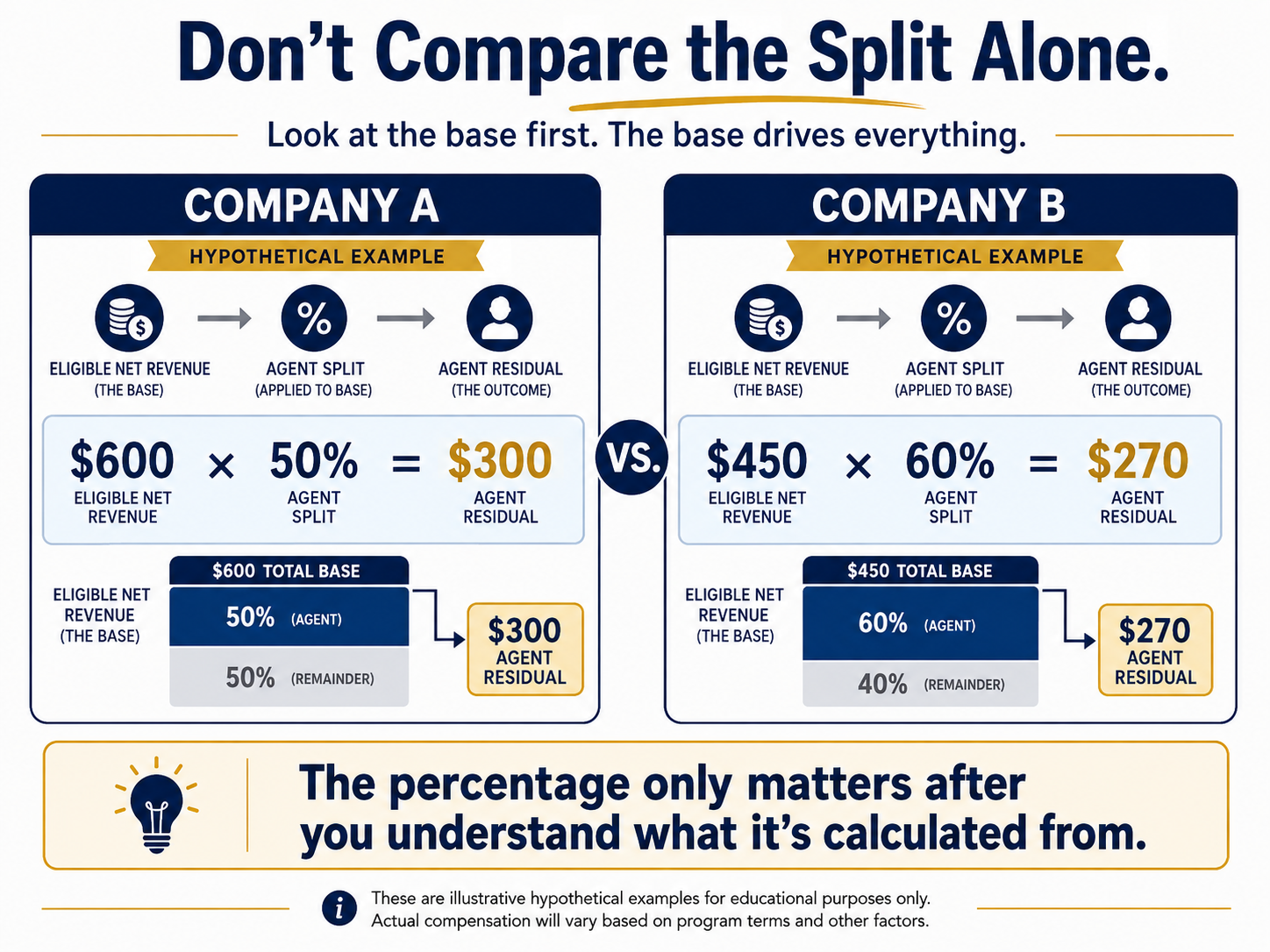
Company A says:
50% residual split.
Company B says:
60%.
The beginner thinks:
Company B obviously pays more.
Not necessarily.
The residual percentage tells you how the eligible profit is divided.
It does not tell you how much profit exists to divide.
If Company B has higher underlying costs, a 60% split can potentially generate a smaller actual payout than a 50% relationship with stronger economics.
That is why I generally like a clean 50% residual arrangement when the economics, residual rights and backend relationship are strong.
If production later supports 55% or 60%, that's even better.
But I don't want people choosing a company simply because someone printed the biggest number on the recruiting page.
Read Merchant Services Residual Splits Explained before comparing programs.
Step 4: Understand the Schedule A
Your residual split and your Schedule A work together.
The Schedule A can contain underlying transaction costs, monthly expenses, statement costs, BIN or sponsorship-related costs and other fees that affect the eligible profit available for revenue sharing.
You don't need to compare fifty individual line items.
You should understand the meaningful ones.
A two-cent transaction-cost difference may seem insignificant.
At 5,000 transactions per month:
$0.02 × 5,000 = $100 per month
That difference can matter more than a higher advertised residual split.
The same principle applies to statement fees, monthly costs and other expenses that multiply across a portfolio.
There is nothing inherently wrong with having costs in a Schedule A.
Everyone in the payment ecosystem has costs.
The question is whether those costs are reasonable and whether you understand how they affect your compensation.
Read Merchant Services Schedule A Explained before signing an agent agreement.
Step 5: Read the Agent Agreement Before You Start Building
This is the step people skip because it isn't exciting.
Do not skip it.
Your agreement may determine:
When your residuals vest.
What happens if you stop producing.
What happens if you leave.
What happens if the relationship is terminated.
Whether costs can change.
Whether production requirements exist.
What can be clawed back.
What restrictions apply to merchant solicitation.
What happens to residual income you've already built.
The compensation plan tells you how attractive the opportunity looks today.
The contract tells you what the relationship may look like years from now.
Start with my 11 Questions to Ask Before Signing a Merchant Services Agent Agreement.
Then review Merchant Services Contract Red Flags.
These resources are educational and do not replace professional legal advice on your actual contract.
Step 6: Understand What "Lifetime Residuals" Really Means
Residual income is one of my favorite things about merchant services.
But use the terminology correctly.
Lifetime residuals generally refer to continuing residual compensation associated with active merchants, subject to the terms of your agreement.
It does not mean a merchant is guaranteed to process forever.
Businesses close.
Owners sell.
Merchants switch providers.
Processing volume changes.
And contractual terms matter.
What you want to understand is whether your residual rights continue if you eventually stop actively selling and what circumstances can cause those rights to terminate.
Read What Lifetime Residuals Really Mean in Merchant Services.
The goal isn't to become cynical about residual income.
It's to understand what you're building.
Step 7: Get Educated and Complete Foundational Certification
This is where Merchant Service University fits into the process.
I created MSU because I got tired of seeing people online charge thousands of dollars for access to merchant services and then hearing from people who had purchased some of those programs and still felt like they had not received the depth of education they expected.
I wanted to create the opposite model.
I make my living working in merchant services.
I don't need to make my living selling you a high-ticket course about the dream of merchant services.
So I invested my own time and money into creating a comprehensive educational process and made the core training free.
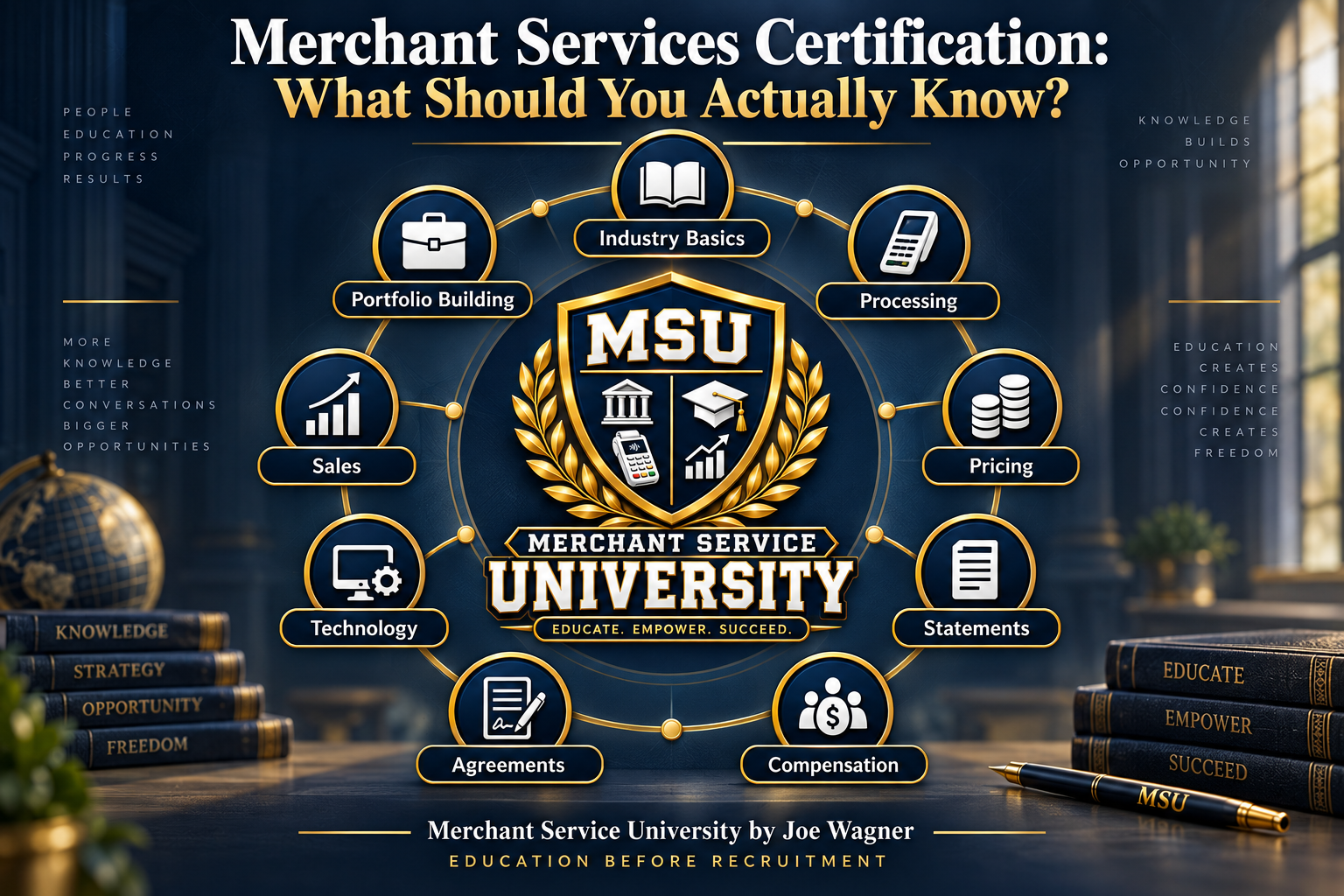
MSU teaches the foundation:
Industry basics.
Processing.
Pricing.
Statements.
Compensation.
Schedule A economics.
Agreements.
Modern commerce systems.
Prospecting.
Sales.
Retention.
Portfolio building.
Then students can complete the required core curriculum and earn Merchant Service University certification.
As I explain in Merchant Services Certification: What Should an Agent Actually Know?, that certification is educational.
It is not a government license.
It does not guarantee income.
It does not make someone a registered ISO.
It simply confirms that you've completed the foundational MSU curriculum.

Step 8: Decide What Kind of Merchant Services Business You Want
Now you can ask the question most people ask first:
Which company should I join?
But before answering it, define your priorities.
Are you primarily interested in long-term recurring residual income?
Do you need meaningful upfront cash flow while building?
Are you already an experienced closer with access to larger merchants?
Do you want to focus on restaurants?
Professional services?
Retail?
Contractors?
Another vertical?
Do you need specific technology?
How important is underwriting flexibility?
How important is merchant support?
What kind of agent support do you need?
This is where different companies begin making sense for different people.
Step 9: Compare Merchant Services Partners Based on YOUR Goals
I work with multiple merchant-services partner relationships for exactly this reason.
I do not believe there is one universal "best merchant services company."
One partner may be stronger for a salesperson who prioritizes substantial upfront compensation.
For example, one of the partners I currently work with can pay up to $10,000 upfront on certain qualified merchant deals based on merchant profitability and program requirements.
That does not mean every merchant pays $10,000.
It is not guaranteed compensation.
But for the right experienced salesperson pursuing highly profitable businesses, the structure can be extremely attractive.
Another partner may not emphasize massive upfront commissions but could offer advantages that matter more to someone building a particular type of residual portfolio.
Different technology.
Different underwriting.
Different support.
Different merchant fit.
All of the partners I consider for agents still need to have economics I believe make sense.
I'm not suggesting someone accept terrible residual compensation just because a company pays an upfront bonus.
The point is:
Different strengths matter to different agents.
That is why I specialize in helping agents understand what matters to them and then discussing which partner may fit those priorities.
Read How to Compare Merchant Services Companies Without Getting Sold before making the decision.
Step 10: Don't Automatically Become a Registered ISO
If you're entrepreneurial, this temptation can come quickly.
You learn merchant services and immediately think:
I should start my own ISO.
Maybe someday.
But most new agents don't need to begin there.
A strong upstream organization can already provide:
Processing relationships.
Underwriting.
Risk infrastructure.
Merchant support.
Technology.
Equipment deployment.
Residual reporting.
Operational systems.
That lets you spend your time doing the thing that actually creates the portfolio:
Selling merchants.
I've explained my view in Merchant Services Agent vs. ISO.
For most sales-focused entrepreneurs, I would rather see them build production before adding unnecessary infrastructure.
Let great operators operate.
Let great salespeople sell.
Step 11: Start Lean
You do not need to spend a fortune before contacting merchants.
A beginner can start with:
A phone.
A prospect list.
A way to track follow-up.
A legitimate merchant-services partner.
Enough education to have a responsible conversation.
Then sell.
You can add the website later.
Upgrade your CRM later.
Buy better data later.
Add automation later.
Spend money once you understand what bottleneck the money is solving.
My article Can You Start Selling Merchant Services for Free? explains why I think new agents should avoid building massive overhead before they build sales.
Step 12: Choose a Prospecting Model and Actually Use It
Merchant services is still a sales business.
No education, certification or processing partner changes that.
You need merchant conversations.
There are multiple ways to create them.
You can work door to door.
Choose a territory.
Identify businesses.
Walk in.
Start conversations.
Follow up.
Or you can use a phone-to-appointment model.
Build lists.
Make calls.
Set appointments.
Run meetings.
You can also use referral relationships, networking, existing business relationships, content marketing and other channels.
The specific approach matters less than consistency.
You need a daily sales process.
A new agent who understands only 70% of the industry but talks to merchants every day will usually learn much faster than someone who knows 95% of the textbook material and never prospects.
Education should prepare you for action.
It should not replace it.
Step 13: Learn Discovery Instead of Memorizing a Pitch
When you finally sit down with the merchant, don't unload every product you sell.
Ask questions.
What are they using?
What do they like?
What frustrates them?
How much are they paying?
How do customers pay?
Do they invoice?
Do they sell online?
Do they need appointments?
Are they manually managing inventory?
Are deposits creating problems?
Is support poor?
Do they actually need anything changed?
The merchant's answers tell you where the opportunity is.
Sometimes the answer is sophisticated commerce technology.
Sometimes it's better processing economics.
Sometimes it's improved support.
Sometimes the merchant just needs a basic terminal.
And sometimes they do not need to change at all.
Good merchant salespeople diagnose before prescribing.
Step 14: Understand Modern Commerce Systems
The opportunity in merchant services is larger than replacing credit-card terminals.
Businesses increasingly use payment technology alongside tools for invoicing, point of sale, e-commerce, online ordering, appointments, customer management, inventory, loyalty, employee management and reporting.
That creates additional ways to bring value to merchants.
But the goal is not to force sophisticated technology into every business.
A small auto-repair shop may simply need a straightforward terminal and fair pricing.
A salon may benefit heavily from appointments and customer management.
A restaurant may need a specialized POS environment.
A contractor may care about mobile payments and invoicing.
The salesperson who understands the merchant's operation has an advantage over the salesperson selling one product to everyone.
Step 15: Understand Basic Payment Security
You are selling access to a financial ecosystem.
Security matters.
A merchant-services agent should understand the basic purpose of PCI DSS and recognize that merchants, processors, acquirers and service providers all exist within a payment-data security environment.
PCI SSC describes PCI DSS as baseline technical and operational requirements designed to protect payment account data.
You do not need to become a PCI assessor to sell merchant services.
You should know enough not to give merchants irresponsible compliance advice.
When something moves beyond your training, involve the appropriate compliance or technical professional.
Step 16: Help the Merchant Get Through Onboarding
The sale is not over when the merchant signs.
Now underwriting begins.
The merchant may need to provide documentation.
The account needs approval.
Equipment or software has to be configured.
The merchant needs to activate.
Funding has to work.
Employees may need training.
This stage matters because friction after the sale can destroy a relationship you just worked hard to create.
I've had to save plenty of merchant relationships over the years simply because a process after the sale became frustrating.
A great salesperson doesn't disappear after the signature.
They help the merchant reach activation.
Step 17: Treat Merchant Support as Part of Your Compensation
This may sound strange, but merchant support affects your income.
Why?
Because residual income depends on merchant retention.
Suppose you receive 60% residuals through a company with poor support and merchants constantly leave.
Another partner gives you 50% but provides strong support, better technology and merchants remain active much longer.
Which relationship ultimately builds the better portfolio?
The percentage alone cannot answer that.
A merchant who leaves generates:
$0 in future residual.
That is why I evaluate support when I evaluate compensation.
The upstream company earns part of the economics because it should be helping protect the backend relationship.
I want my ISO to make money.
I want them financially healthy.
I want them motivated to support the merchant.
This should be a mutually profitable business relationship.
Step 18: Think Portfolio, Not Commission
This is where merchant services becomes truly interesting.
The goal isn't:
Close merchant. Get paid. Restart next month.
The goal is:
Close merchant.
Retain merchant.
Add another merchant.
Then another.
Then another.
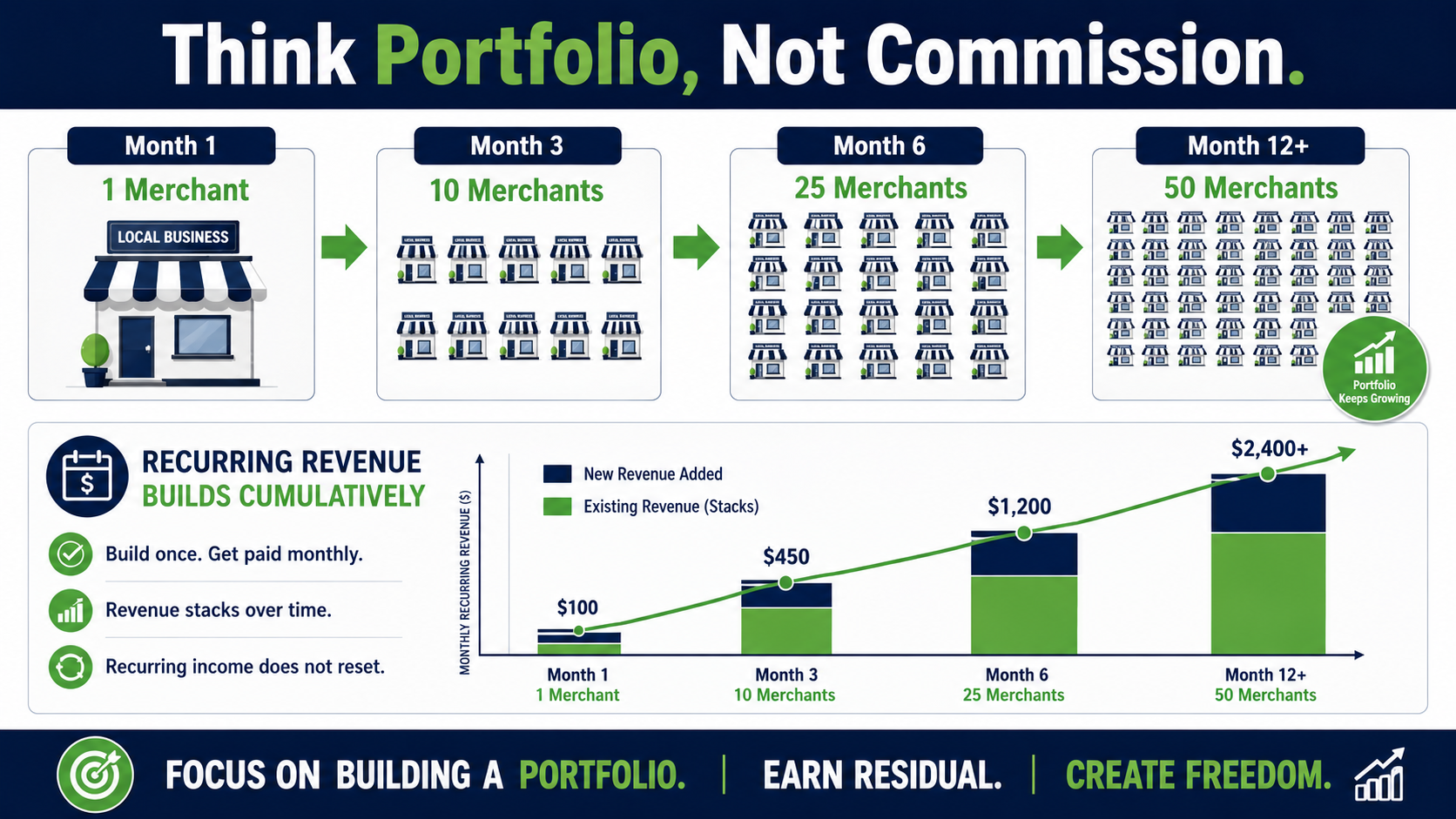
If those merchants remain active and your residual rights remain intact, previous sales can continue contributing recurring compensation while you're making new sales.
One merchant becomes ten.
Ten becomes twenty-five.
Twenty-five becomes fifty.
Fifty can become one hundred.
You are building a book of merchant relationships.
That is why the agreement matters so much.
That is why the Schedule A matters.
That is why the residual split matters.
That is why support matters.
You're not simply negotiating the commission from today's sale.
You're determining the economics of a portfolio you may spend years building.
Step 19: Keep Learning After Your First Merchant
Certification isn't the end.
Your first merchant will teach you something.
Your tenth will teach you more.
You will encounter:
New objections.
Different business models.
Underwriting challenges.
Pricing situations.
Technology questions.
Support issues.
Competitors.
Merchant retention problems.
That's normal.
The goal of foundational education is not eliminating the learning curve.
It is preventing you from entering the learning curve completely blind.
Use Merchant Services Training: What Every New Agent Should Learn as an ongoing roadmap rather than a one-time checklist.
Step 20: Measure Merchant Growth, Not Just Recruiting Excitement
There is an important final distinction.
Becoming a merchant-services agent is easy compared with becoming a productive merchant-services agent.
Signing an agent agreement doesn't create a business.
Getting certified doesn't create a business.
Creating a logo doesn't create a business.
Buying a CRM doesn't create a business.
Posting that you're now in payments doesn't create a business.
Merchants create the business.
How many merchant conversations are you creating?
How many appointments?
How many proposals?
How many accounts boarded?
How many accounts activated?
How many stay?
How much recurring portfolio revenue is being built?
Those are the numbers that eventually matter.
What I Would Do If I Were Starting Merchant Services From Zero in 2026
If I had to restart today, here's the path I would follow.
First, I would learn the industry without spending a fortune.
I would complete the core Merchant Service University education and make sure I understood processing, compensation, Schedule A economics, agreements and merchant technology.
Then I would define my goals.
Do I want large upfront commissions?
Long-term residuals?
Both?
Which types of merchants do I want to pursue?
Then I would evaluate several legitimate partner structures based on those priorities.
I would read the agreement.
I would understand the major Schedule A costs.
I would make sure the residual rights fit what I wanted to build.
Then I would stop researching.
I would build a list.
I would start prospecting.
I would learn from real merchants.
I would get my first account activated.
Then I would get another.
I wouldn't spend my first six months trying to look like a massive payment company.
I would spend them becoming a productive salesperson.
How I Help New and Experienced Merchant Services Agents
This is the role I've built around Merchant Service University.
For someone new, start with education.
Learn the business free.
Complete the core certification.
Then, if you want help, we can discuss what you're trying to build.
For someone already experienced in merchant services, you may not need beginner training.
Maybe you need a different partner.
Maybe you need stronger upfront compensation.
Maybe you need better residual economics.
Maybe you need stronger technology.
Maybe underwriting is creating problems.
Maybe support is causing merchant attrition.
Or maybe your existing company is excellent and you should stay exactly where you are.
I'm not interested in moving someone merely for the sake of moving them.
I want to understand the problem first.
Then we can discuss whether one of the partner relationships I work with actually provides a better solution.
That's the same approach I want agents using with merchants.
Diagnose first. Recommend second.
The Complete Path to Becoming a Merchant Services Agent
If you want the entire article reduced to one roadmap, this is it:
1. Learn Merchant Services
Understand the industry and payment flow.
2. Learn Compensation
Understand upfront commissions, residuals and how agents actually get paid.
3. Understand Schedule A Economics
Know the major costs underneath your residual.
4. Understand the Agent Agreement
Know vesting, termination, clawbacks and residual rights.
5. Complete Foundational Training
Use MSU or another credible educational process to build your foundation.
6. Get Certified
Confirm you've completed the foundational MSU education.
7. Define Your Goals
Decide what type of income, merchant market and business model you want.
8. Compare Partners
Evaluate economics, contracts, technology, underwriting and support.
9. Choose a Partner
Select the relationship that fits what you're trying to build.
10. Start Prospecting
Create merchant conversations.
11. Learn Discovery
Diagnose merchant problems before presenting solutions.
12. Close and Activate Merchants
Don't stop at the signed application.
13. Support and Retain
Protect the relationship after the sale.
14. Build the Portfolio
Keep adding merchants while protecting the ones you already have.
15. Keep Learning
Experience becomes the next level of education.
That's how I would build the business.
Frequently Asked Questions About Becoming a Merchant Services Agent
How do I become a merchant services agent?
Start by learning the payment-processing industry, understanding agent compensation and agreements, completing foundational training, and then partnering with a legitimate merchant-services organization. After onboarding, the actual business is built through prospecting, merchant acquisition and retention.
Do I need experience to become a merchant services agent?
Not necessarily. Previous B2B or commission-sales experience can help, but beginners can learn the payment-processing fundamentals and sales skills needed to begin.
Do I need a license to sell merchant services?
There is not one universal government-issued merchant-services salesperson license required of every individual rep. However, companies, card networks and particular payment roles can have contractual, registration, compliance and onboarding requirements.
Do I need to become a registered ISO?
No. Many merchant-services salespeople work through established ISOs or processing organizations that provide backend infrastructure. Becoming a registered ISO is a separate business decision and is not required simply to begin selling as an agent.
How much does it cost to become a merchant services agent?
Startup costs vary. It is possible to begin the education and agent path with very little overhead through an established partner. Optional costs such as business formation, websites, CRMs, advertising, travel and advanced training depend on how you choose to build.
Can I learn merchant services for free?
Yes. Merchant Service University provides free core education covering payment-processing fundamentals, compensation, pricing, agreements, technology and sales.
What is a good residual split for a merchant services agent?
A clean 50% residual arrangement can be strong when the underlying costs, contractual residual rights and support structure are competitive. Higher percentages are not automatically better if the economics underneath them are weaker.
Can merchant services agents get paid upfront?
Yes. Some programs offer upfront compensation in addition to recurring residual income. Compensation varies by account and program. One partner Joe Wagner works with can pay up to $10,000 on certain qualified merchant accounts based on profitability and program requirements.
What are lifetime residuals?
Lifetime residuals generally describe continuing agent compensation from active merchant accounts, subject to the terms of the agent agreement. They are not guaranteed income forever.
How long does it take to become a merchant services agent?
The foundational concepts can be learned relatively quickly, but becoming effective at merchant sales requires ongoing prospecting and real-world experience. The exact onboarding timeline also varies by processing partner.
Is Merchant Service University required to sell merchant services?
No. MSU is an educational program, not a legal licensing requirement. Its purpose is to help people understand the industry before choosing a partner.
What does MSU certification mean?
MSU certification confirms completion of the required foundational Merchant Service University curriculum. It is an educational credential, not a government license or card-network registration.
How do I choose a merchant services company?
Compare the partner based on residual economics, major Schedule A costs, upfront compensation, residual rights, agreement terms, technology, underwriting, merchant support and your own business goals.
Can Joe Wagner help me choose a merchant services partner?
Yes. Joe works with multiple merchant-services partner relationships and helps new and experienced agents think through potential fits based on priorities such as residual income, upfront compensation, technology, underwriting and support.
Where should I start?
Begin the free core education at MerchantServiceUniversity.com.
Final Takeaway: Learn First. Then Build.
If you're wondering how to become a merchant services agent in 2026, you don't need to make the process more complicated than it is.
You need education.
You need the right partner.
And then you need to sell.
Learn how payments work.
Understand how you're paid.
Understand the Schedule A.
Read the agreement.
Know what lifetime residuals actually mean.
Understand what merchants need.
Get foundational training.
Get certified.
Define your goals.
Choose a processing relationship that fits those goals.
Then stop preparing forever.
Start talking to merchants.
Get the first one.
Help them activate.
Take care of them.
Get the second one.
Then the tenth.
Then the twenty-fifth.
Then the fiftieth.
That's how the portfolio gets built.
Merchant services has been my industry for more than 16 years, and I still believe the combination of real merchant value, sales opportunity and recurring portfolio economics makes it an incredible business for the right salesperson.
But you don't need someone online selling you the dream.
You need to understand the business.
That's why I built Merchant Service University.
I invested my own time and money into creating the educational process because I make my living doing merchant services, not selling you an expensive course about merchant services.
The core education is free.
There is no obligation to join one specific processing company.
Learn first.
Get certified.
Then, if you want my help deciding what comes next, reach out through JoeWagner.com.
We can talk about what you're trying to build and whether one of the partner relationships I work with makes sense for you.
Get educated before you get recruited.
Then go build the portfolio.
About Joe Wagner
Joe Wagner has spent more than 16 years in merchant services and payment-processing sales, acquiring merchants, building recurring-revenue portfolios and developing sales organizations.
He created Merchant Service University to give new and experienced salespeople access to foundational merchant-services education before requiring them to choose a processing partner.
Joe also works with merchant-sales representatives who want help evaluating potential partner opportunities based on residual economics, upfront compensation, technology, underwriting, support and long-term portfolio goals.
To continue your research, start with the Merchant Services Sales Beginner's Guide, learn How Merchant Services Agents Get Paid, review How to Choose a Merchant Services Agent Program, understand Merchant Services Schedule A, read Merchant Services Residual Splits Explained, learn What Lifetime Residuals Really Mean, review Merchant Services Training for Beginners, learn What Merchant Service University Is, and review the Merchant Services Certification Standard.
Or begin the free core training now at MerchantServiceUniversity.com.